“This Jagdish Patel incident is not going to stop people of Dingucha from going to America through an illegal route,” said Janvi Sonaiya, editor at the news organization, Vibes of India who broke the story and conducted research in Dingucha.
Multiple factors are responsible for drawing people to America according to Sonaiya. One of the most crucial reasons is unemployment. Most people in Dingucha have two major jobs - agriculture or working as laborers in factories where they are often exploited.
Matherji Thakor, the village chief of Dingucha, said that the government does not provide the required financial assistance to the village and so many people are left without a choice. A 2020 report released by the Reserve Bank of India states that rural unemployment in Gujarat has risen over tenfold since 2011. So, many of the villagers are forced to migrate to larger cities but struggle to make more money. As the last resort, they go to the United States so that they can send money back home.
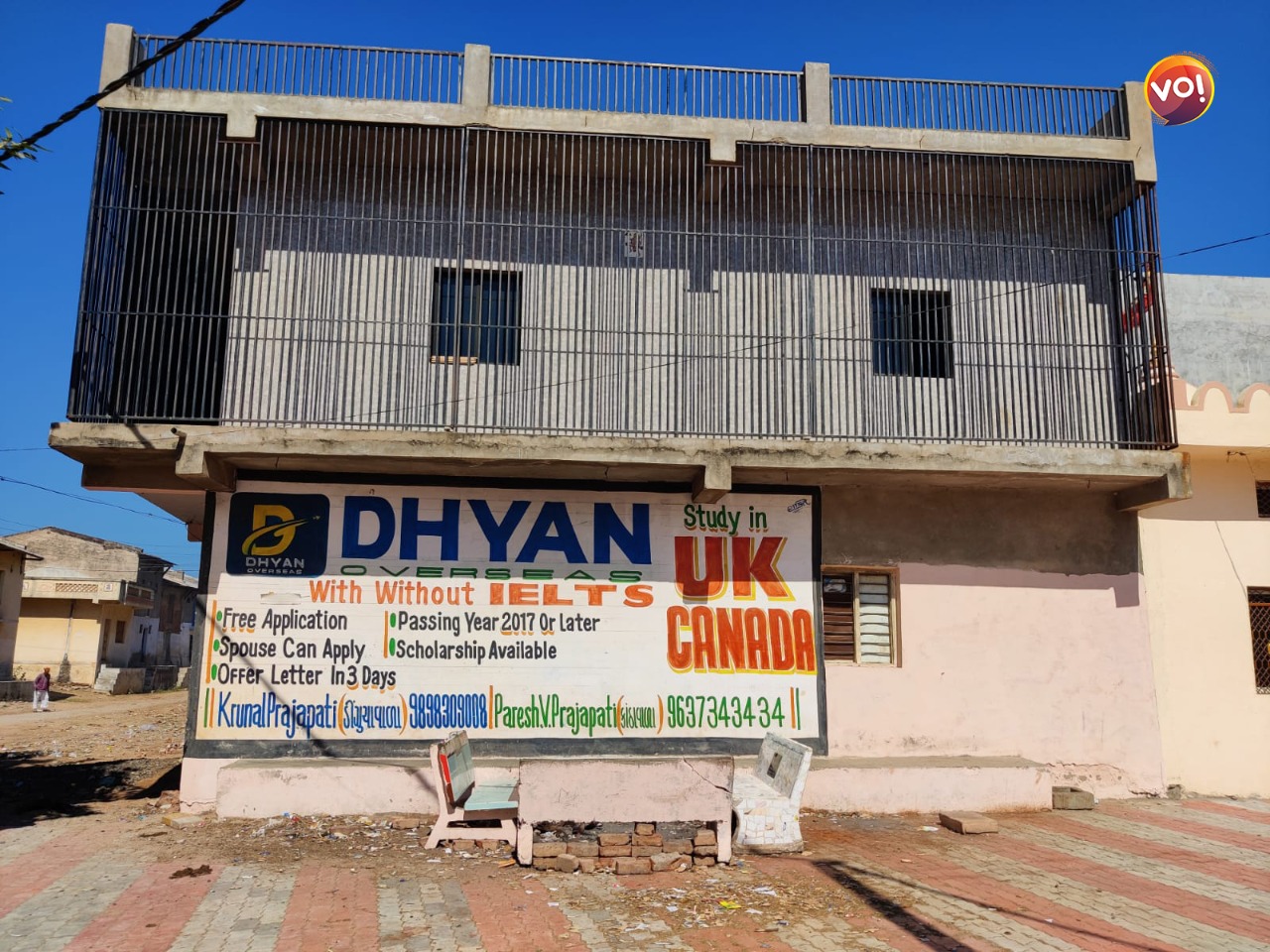
An advertisement in Dingucha village says it provides services for visas with or without giving English-proficiency exams that are usually required. (Photo courtesy: Vibes of India)
It’s not only Jagdish Patel who has thought of taking such a perilous journey. Many residents of Dingucha have considered going to the U.S. in any way possible because of casteist disadvantages. It is difficult to determine how many people are affected by casteism or lack of equal opportunities and employment because of a lack of data and infrequent government censuses. Caste, however, is only part of the problem.
“When two communities or castes are like fighting against each other, then it's not just unemployment. There are social disadvantages like the way they are treated - everything needs to be seen in totality,” said Sonaiya. “If you think about Dingucha village, irrespective of the caste or the conflicts, you will see that they have all kinds of divisions — not having enough education, sanitation, electricity, or jobs. So, irrespective of which caste is fighting for what, the entire village is at a disadvantage.”
The death of Jagdish Patel’s family brought the situation in Dingucha to light, but the places like Anand and other smaller towns and villages have the same stories when it comes to illegal migration. Most people who choose these routes are above 30 years of age and still haven’t found stable employment.
It is not that the Patel community does not have success stories. Many of them have been immensely successful in business like the Patel Brothers - a highly successful grocery chain founded in 1974. The success of the first-generation immigrants made it easier for the generations that followed.
“It's not that they just came here and were successful overnight,” said Sriram. “They worked really hard. They established their own networks. They brought over other people in their families to help with their businesses. They established lines of credit for other people. They took care of their own. They intermarried within their own community. And I think they did that on purpose to allow them to establish themselves to be very strong.”
In America, they already have an established support network within the community, where they will be employed in some motel or fast-food chain. They will earn in cash from wages and tips but it will be much more than what they used to earn in India. This is why many people from these villages rush to the United States.