How is wealth measured? In a world that can calculate net worth to the penny, local poet Robert Williams would hardly count as a rich man.
He takes a deep breath and slowly gets out of his seat. He walks slowly to the front of the Los Angeles Metro rail car, and says five words that could potentially pay his bills and give someone hope in a community where it is hard to come by: “May I have your attention, please?”
Williams rides the Metro system not only for cheaper transportation, but also as a means of financial gratification. He reads inspirational poetry to the passengers, in exchange for donations, but most of all, he hopes his words can give passengers the strength to carry on another day.
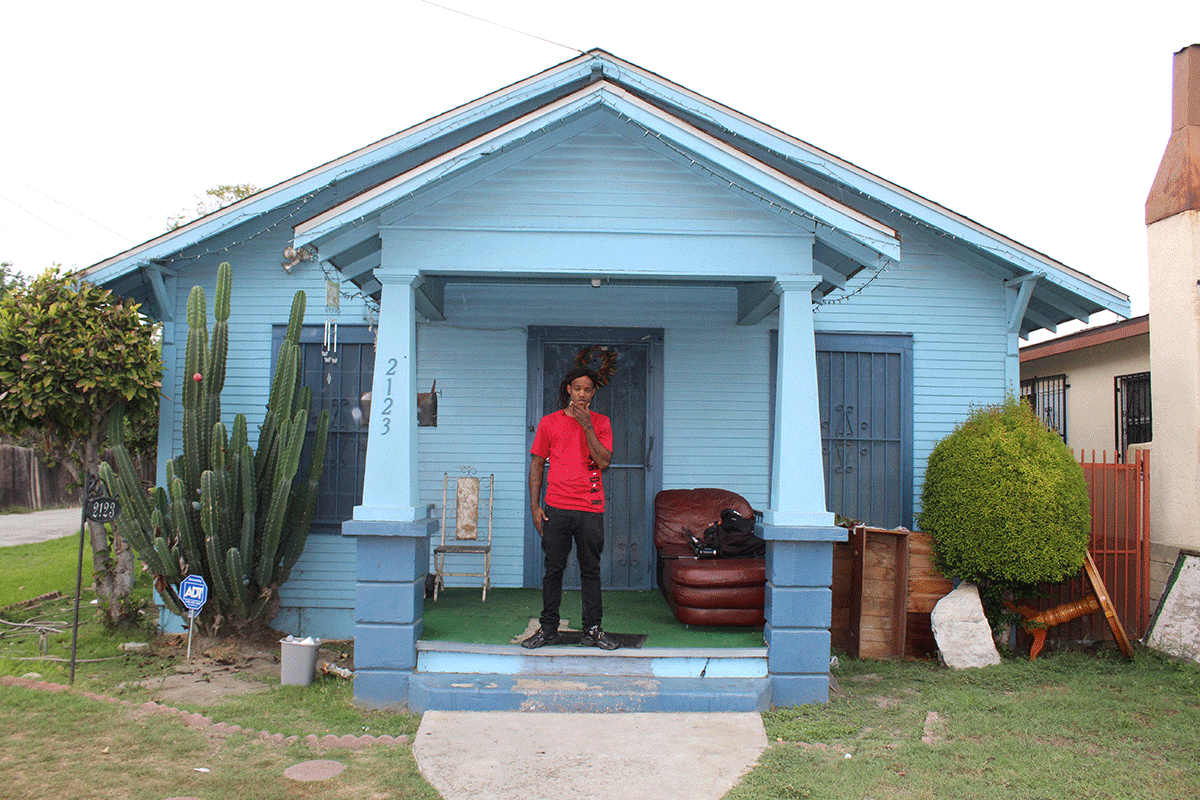
After spreading his poetry to the community, he gets back in his car and drives back to his house deep in the heart of Watts.
His room feels like an 8’ x 8’ phone booth that consists of a beat up futon and shelves that houses glossy handouts of his poems and a tattoo kit. The walls that enclose the room look as if they could bend to the will of a calm breeze, and breathes more than a moth-ravaged sweater.
Despite his humble appearance, Williams carries himself like a person who has everything. His smile is infectious and his confidence when reciting poetry draws in even the most hardened South Los Angeles resident like a harmless siren song.
To see this video on YouTube, click here
In addition to riding the Metro, he is also employed as a tutor and writing coach where he wants to help children channel their frustrations towards words rather than weapons.
Rounding out his creative hustle is hosting open mic nights every Thursday at Vibrations, a poetry lounge located in nearby Inglewood. Not only does he share his passion for poetry, he also enjoys letting others share their love for the craft, always seeking new sources of inspiration to utilize in his own work.
Williams is the living embodiment of Tupac Shakur’s “Rose that Grew from the Concrete” – a beautiful gem that burst out against all odds and obstacles that a harsh environment provides.
“One guy was mean when I was reading one of my poems, and another guy wanted to hear my poems so bad that he walked to the back and hit the other guy,” Williams said. “Two other people jumped the guy.”
“There’s very discouraging people on the train. That was one of the worst things I’ve seen. I’m still visualizing it to this day.”
Before he was able to break out of the disheartening environment of the Metro and South Los Angeles, he was hardened by struggles that gave him the strength to be a shining light for the community.
Williams encountered tragedy at a young age when his older brother was shot and killed two days after Christmas in 1990. The loss of his brother was overwhelming, but it resulted in his exposure to poetry.
Williams’ mother wrote a poem commemorating his brother; little did Williams know that this would be the origin of his poetic practice today.
Williams' version of his mom's poem. To hear this on SoundCloud, click here
“The poem was so good that I thought someone else wrote it,” Williams said. “She printed out 1000 copies, and she was just giving them out to people who lost their family.”
Family provided Williams with one of his most prized skills and passions, but it also would give him some of his most trying situations. This would become a common theme for the young Los Angeles poet and test him as he was put through his paces learning the art form.
Though Williams himself was not a child that came from wealth, he had relatives that surrounded him with it early in life. His uncle Jay Pugh was a producer for Run DMC and provided the beat for “It’s Tricky.” Pugh’s success gave Williams an early avenue to get his career off the ground, but it did not lead to any immediate success.
Pugh set him up with a car and a room in a house with a recording studio in hopes that Williams would be able to realize his dream.
In order to afford the $700 rent in a house with a studio that his uncle suggested, he had to work two jobs at two McDonalds locations in Calabasas and North Hollywood. However, he was unable to get the help he needed from his uncle.
The studio was booked for days at a time, and Williams felt that Pugh sold him on the idea that he would have more access than what was available. Eventually, the situation was not working for Williams and Pugh, sending both men on their separate paths.
“I was there so long that I was coming up with McDonalds songs,” Williams said. “I thought I was going to blow up, but I wasn't able to push any of my product”
Although Williams is now on track to live his dream as a successful street poet, an environment that threatens to pull him back down is present like a dark figure looming over his shoulder.
He is currently fighting to get joint custody of his daughter, Love Williams. Recently, he says unanswered texts and calls with his daughter’s mother have become the norm and Williams is left to battle to see his daughter regularly.
“I’ve been through a lot of the past couple months,” Williams said. “I’ve been there [for her] since day one.”
Still, Williams puts on that bright smile and walks onto the uneven concrete of South Los Angeles reading poetry – not only because it is something he wants, but also because it is something he needs. He harnesses his frustrations and uses his poetry for mental relief when external pressures take hold of him.
Williams venting frustrations sometimes results in poetry. To hear this poem on SoundCloud, click here
“After we’re done with this, I don’t have to go back out on the train, it’s just something that’s inside of me that tells me ‘you’re obligated to do this,’” Williams said. “They’re still selling drugs out there, and if this poetry is not going to happen, what’s going to happen?"
"Are we going to keep living like this?”Though the environment and its pitfalls, like custody battles and racism within his race, are constantly trying to pull him back, Williams finds a way to shake off the discouragement and distraction to deliver what he feels is his duty to the community.
He may not have monetary riches like his uncle, but he does share the wealth of his personality and compassion for those who are struggling. Williams also shares with others his most valuable asset – his words.
“Just know, one day my poetry will change this community.”
--
Follow Daniel Tran on Twitter @DanTranCA