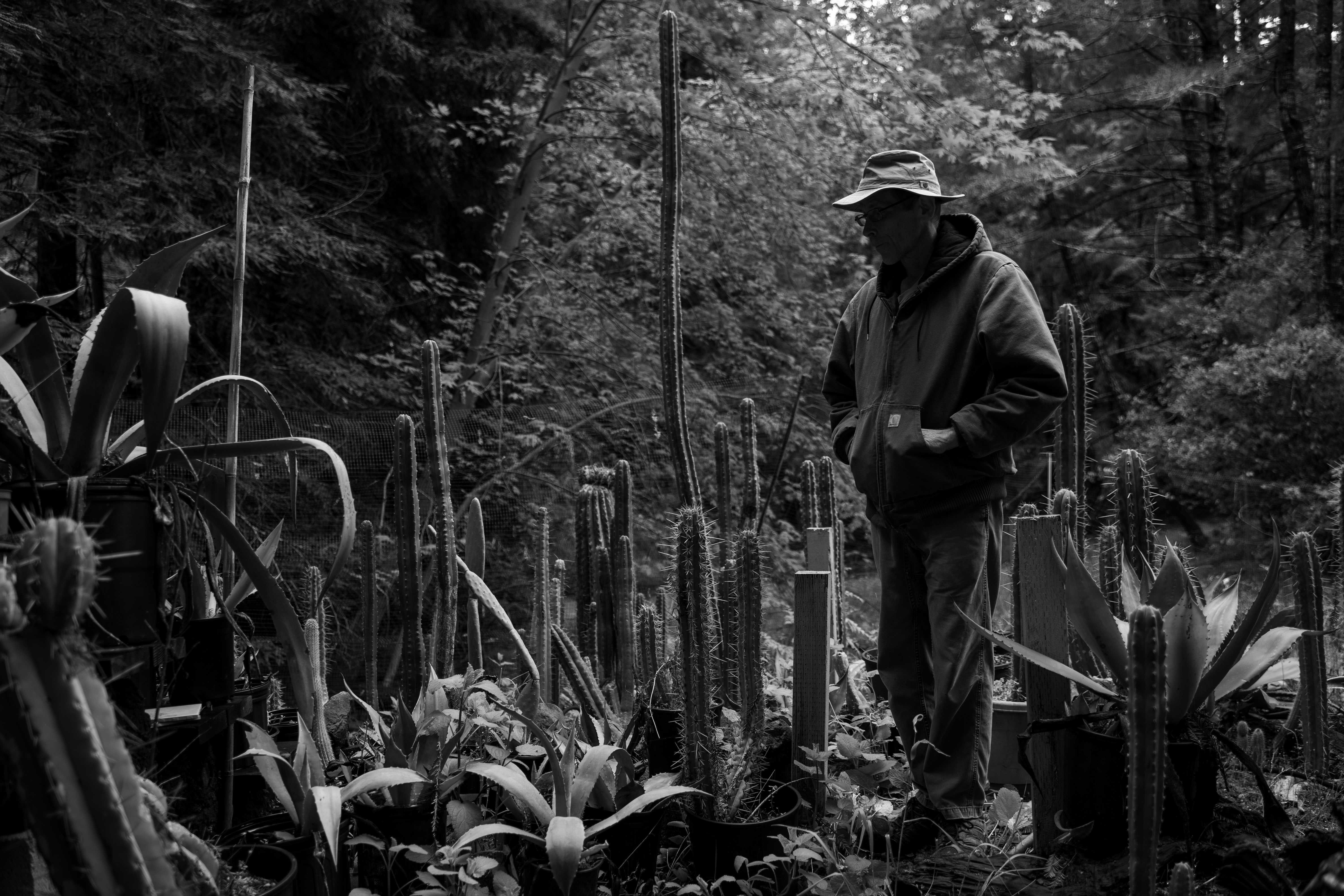
Keeper Trout stands in his cactus garden
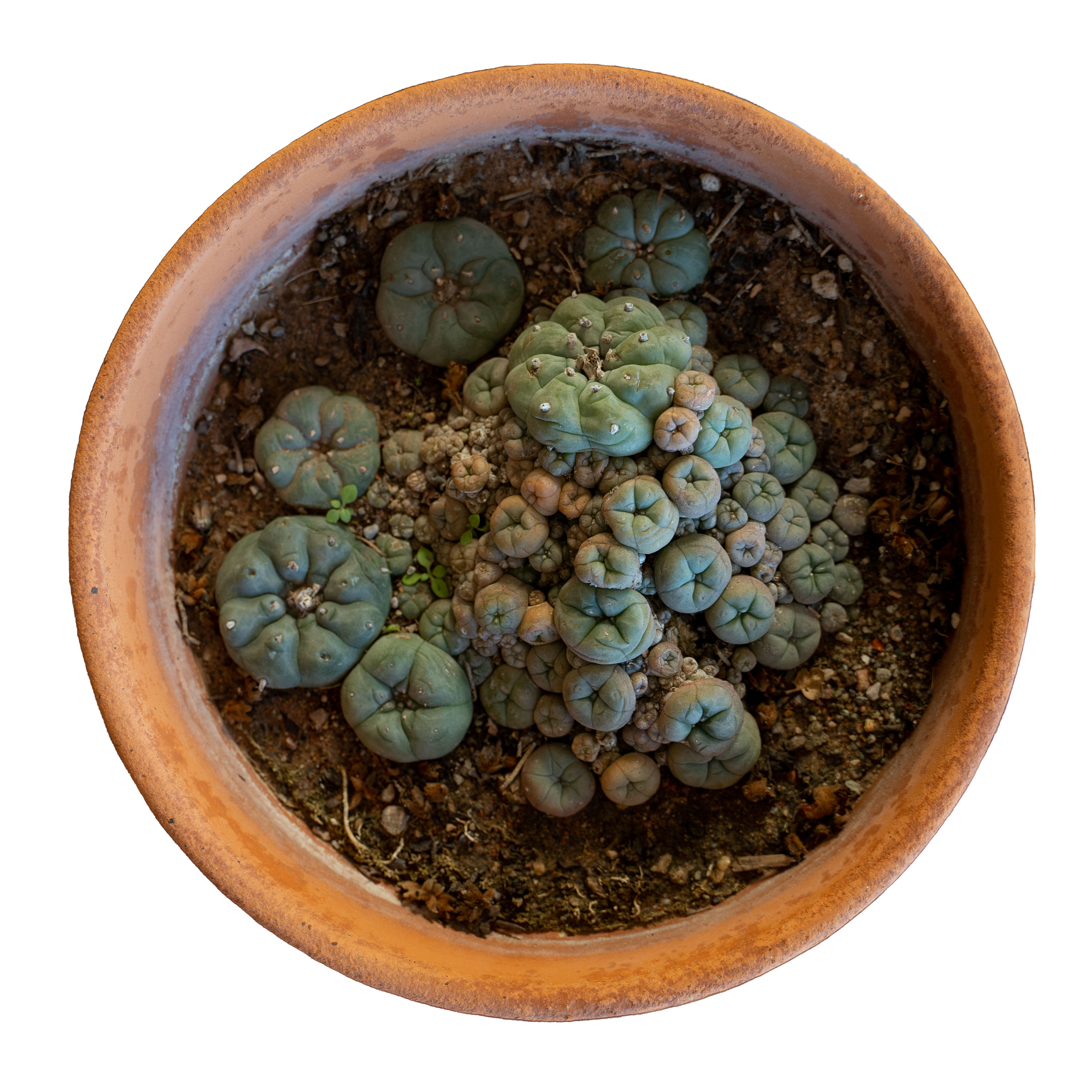
Keeper Trout puts a small, spineless cactus between his teeth. He gnaws its leathery flesh and forces himself to swallow. It is bitter and difficult to keep down, but Trout puts another cactus in his mouth and repeats the process until his stomach cannot hold any more.
A slow nausea creeps over him. Trout feels warm, his heart beats fast and hard.
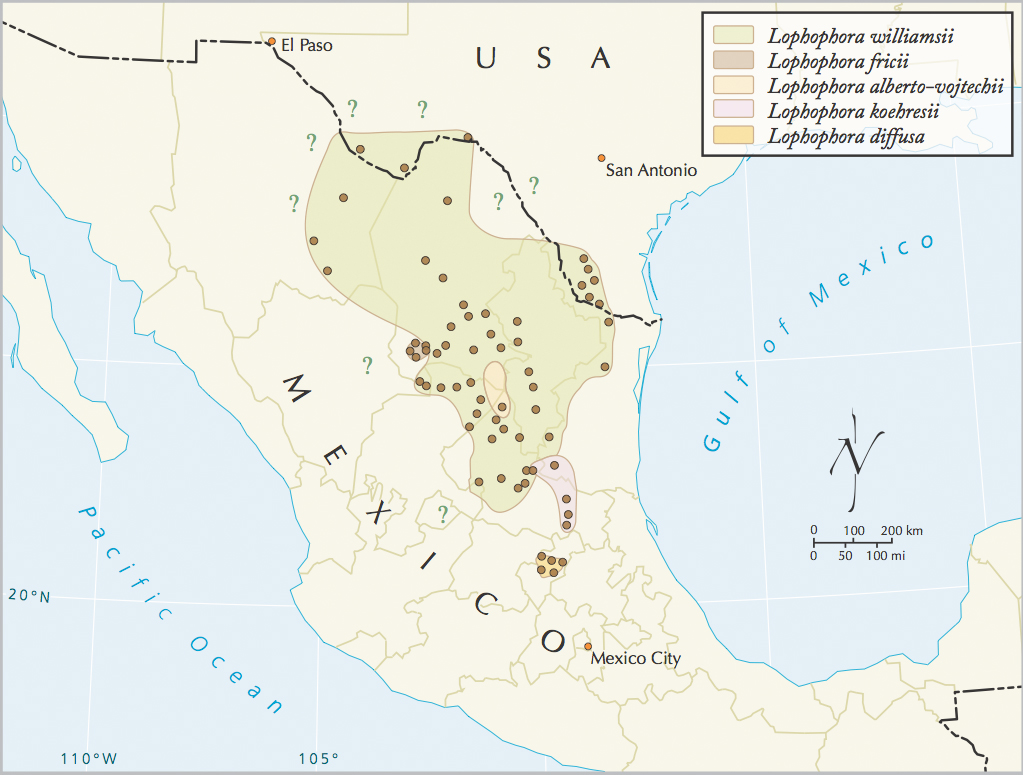
Map of peyote gardens from Martin Terry's research paper 'Stalking the wild Lophophora'
Three hours after filling his gut, the full effects kick in. His world looks brighter and fills with impossible colors. His thoughts become a web of enlightened connections. His mind is clearer than he ever remembers it being.
Trout uses the cactus as medicine. He seeks out its wisdom and healing properties. He loves the plant and feels as though the plant loves him back.
Trout was raised by a preacher in the Midwest, but he is not a religious man. This is as close as he gets to the divine.
Out on the plains of West Texas, Trout is on a pilgrimage. Besides the mountain scrublands stretching across the border into Mexico, this is the only place Lophophora williamsii grows in the wild. These are the "peyote gardens."
A century ago, ranchers described an overwhelming abundance of the plant. A carpet of cactus covered the arid ground. But Trout sees something different.
Under the agave and greasewood shrubs that peyote normally uses to hide from the sun, there is only dirt. The cactus sea that once soaked this patch of earth is running dry.
Trout looks out onto this dying place and grieves. He thinks about the lessons peyote has given him, the love it has shown him, and he promises never to eat another button again.
Forty years later, Trout sits in a spacious cabin surrounded by Douglas Firs and Coast Redwoods somewhere deep in the forests of Northern California. His face is thin and long, his pale blue eyes sit behind wire frames, his thinning gray hair hides under a drooping boonie hat. Psychedelic rugs stretch out across the floor, a collection of well-used hand drums sit in a corner, and on the center mantle, a seven-foot wooden fish carving – Trout’s namesake – rests against worn brick.
ENTHEOGEN: A substance ingested to cause a non-ordinary state of consciousness for spiritual purposes.
For the past four decades, Trout has dedicated his life to studying and preserving peyote. His website Trout’s Notes is an ever-expanding entheogen encyclopedia. He researches peyote’s anthropological significance, biological and chemical makeup, and, most troublingly, continued decline.
“The vast majority of peyote habitat has been compromised,” Trout says. “So much has been destroyed.”
Blame urban sprawl and agriculture. Over the decades, they destroyed “90-95% of the original brushland in Texas,” Trout laments.
This has spelled disaster for peyote and those who care for the cactus.
PSYCHOTROPIC: Relating to drugs that change a person's mental state.
Trout’s reverence for peyote is not unique. For at least 6,000 years, Indigenous peoples have sought out this fist-sized, blue-green, psychotropic cactus.
Some tribes integrate peyote into everyday life, starting from a very young age.
WIXÁRIKA: An Indigenous tribe native to Mexico and parts of the United States. Their history with peyote is among the oldest of any Indigenous peoples.
“As a baby, you try it in your mother’s milk,” Aikutzi Valadez, a Wixárika woman, says. “You have it as you’re growing up. It’s part of our tradition and culture.”
Many tribes use the cactus religiously. In the late 19th century, Indigenous leaders founded the Native American Church, synthesizing Christian and Native American beliefs and integrating peyote ceremonies.
Such ceremonies evolved over time. Today most tribes that accept the cactus as a religious sacrament participate in Big Moon and Half Moon Ceremonies.
At sundown, participants gather in a teepee. A horseshoe or crescent-shaped earthen altar and a sacred fire are built at the center, with participants gathered around, consuming the sacred cactus, praying, singing, engaging in water-rites, and communing with peyote for its supposed emotional, physical, and spiritual healing properties.
SCHEDULE I SUBSTANCE: A drug with no accepted medical use and high potential for abuse. Penalties for distribution can be up to 15 years in prison and a $250,000 fine.
Non-federally recognized tribes, like the Lipan Apache of Texas, are still prohibited from consuming peyote. Even still, many continue growing and using peyote for spiritual and medicinal purposes.
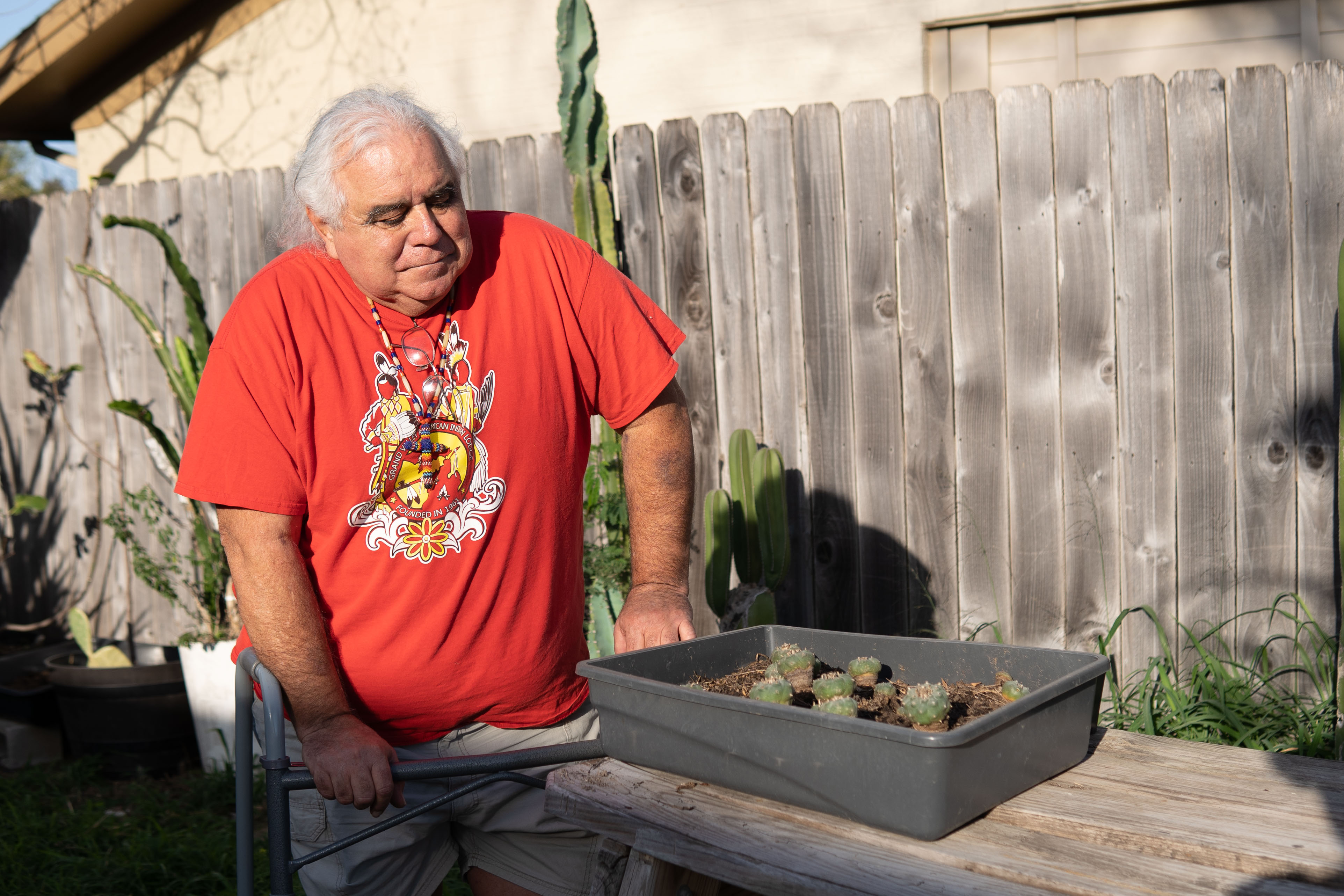
Lipan Apache Vice-Chairman Robert Soto looks at his illicit peyote.
Spurred by anti-drug and xenophobic sentiments, the U.S. government banned the cultivation and distribution of peyote in 1965, and five years later, labeled the cactus a Schedule I substance. After fierce opposition from church leaders on grounds that the law violated their religious liberties, Congress passed the American Indian Religious Freedom Act in 1978 and amended it in 1994, permitting federally recognized Native American Church members to cultivate, harvest, distribute, and ceremonially consume peyote.
The battle over peyote, however, is far from over.
In 1995, church leaders declared a ‘peyote crisis’ as the legal supply struggled to keep up with the demand for as much as 10 million buttons per year. Due to habitat destruction and unsustainable harvesting practices, supply has only dwindled further since the 1990s.
Texas Department of Public Safety data shows that from 1997 to 2016, annual harvests fell from 2.3 million to under 900,000. In 2009, the International Union for Conservation of Nature and Natural Resources declared Lophophora williamsii vulnerable to extinction.
Even as a witness of the cactus’ decades-long decline, Trout rejects the possibility of complete peyote obliteration.
“Peyote is not threatened with extinction,” Trout says. “It’s threatened with extirpation, which is local extinction. Accessible peyote could in fact disappear from overharvesting, overuse, and land conversion, but there will always be some inaccessible location, some place with no roads going to it that nobody knows is there, where peyote is going to survive.”
Though he is confident in peyote’s longevity, Trout recognizes the threat of “the extinction of the sacrament.” If accessible peyote is gone, hundreds of thousands of church members will lose an integral part of their faith.
To avoid such a future, Trout joined forces with researcher Martin Terry and conservation advocate Blake Williams to found the Cactus Conservation Institute in 2004. Their efforts have involved land acquisition projects, sustainable harvesting education, extensive research and cultivation advocacy for Indigenous communities across the country.
Other advocates emerged too. Decriminalize Nature, founded in 2019 by Carlos Plazola, proposes even more radical changes in the name of access and conservation.
The organization's platform calls for the decriminalization of peyote cultivation by Federally Recognized Tribes and Native American Churches as well as personal cultivation by non-Indigenous people.
Plazola, whose paternal ancestry is Nahua, says it is vital to expand peyote rights beyond Indigenous people.
“Peyote is a medicine to heal all of humanity,” Plazola says. “Not just the Indian people.”
Plazola’s personal experience with the healing power of plant medicines drives his passion for decriminalization. After the death of his mother, Plazola turned to magic mushrooms to find meaning in his life.
“When she died, it left me in a state of cosmic nihilism,” Plazola says. “I took five grams of mushrooms and it changed everything. At that moment, I saw the infinite. I found all the answers I was looking for.”
When the overwhelming awe of synesthesia and euphoria subsided, another emotion took its place: rage.
Plazola was furious that plant medicines had been hidden from his community, so he decided to change that. With support from Indigenous and non-Indigenous allies alike, Decriminalize Nature helped make their home city of Oakland the second in the U.S. to decriminalize magic mushrooms.
Board member Aikutzi Valadez gave an impassioned speech at city hall that helped secure the organization’s legislative victory.
“These are Mother Earth’s plants,” Valadez recounts. “They’re for all of us. It is our freedom and right to have these plants because they are sacred sacraments. They really are magical medicines.”
With chapters in cities across the country, Decriminalize Nature continues working toward expanding access to entheogenic plants and fungi.
The group is not without its opponents, however.
The National Council of Native American Churches and Indigenous Peyote Conservation Initiative oppose peyote’s decriminalization. In a joint 2020 statement, both organizations cited “a shortage of peyote available for Indigenous practitioners,” as reason to keep peyote rights exclusive to Federally Recognized Tribes.
They have succeeded in keeping the cactus out of psychedelic decriminalization legislation, like California’s SB 519 that aims to decriminalize magic mushrooms, LSD, MDMA, and other hallucinogenic substances.
Decriminalize Nature claims expanding cultivation to non-Indigenous communities would increase available peyote because the cactus could be grown at home. With the freedom to self-cultivate, non-Indigenous peyote consumers would not have to rely on illegally acquiring the cactus from the peyote gardens, thereby increasing the amount available for Native American Church members.
But some opponents to decriminalization view the expansion of peyote rights to non-Indigenous people as disrespectful to Native Americans.
Troy, a Comanche eagle priest, advocates for exclusive Indigenous peyote rights.
“Indigenous people have only asked for one thing ever: Leave peyote alone,” Troy says. “You’ve stolen their lands, you screwed up their families, you screwed up their cultures. You signed all kinds of treaties and you’ve broken every one. They are traumatized by white people, and now, Decriminalize Nature, Carlos specifically, is trying to traumatize them again.”
Troy was born into a white family in northern Ohio, but has lived as a Comanche in Oklahoma since being adopted into the tribe decades ago. With the Comanche, Troy has spent much of his time working with eagles, even founding Sia: The Comanche Nation Ethno-Ornithological Initiative.
Troy views the decriminalization movement as mostly people intent on securing mescaline, the primary psychoactive compound in peyote, instead of people genuinely seeking the sacrament.
“It’s hard for white people to get that this is ceremonial,” Troy says. “If you want mescaline, you can get it from other plants. You don’t have to touch peyote.”
Plazola disagrees with Troy’s analysis of white peyote seekers.
“White people have developed really strong reverence-based relationships with peyote,” Plazola says. “The color of your skin is transcended by spirit, and if you’re connecting with the spirit of peyote in a real way, you’re no longer white. You may have a white experience, but you’re spirit at that point.”
For Trout, a white man, reverence for peyote has guided him most of his life. His connection to the cactus goes beyond research and admiration.
“For decades, I’ve felt that there’s a peyote button in place of my heart,” Trout says. “I’m in service to peyote and happy to be in service. I would lay down my life in defense of that plant.”
Much like Plazola’s passion for decriminalization, Trout’s dedication to peyote preservation draws criticism. When he advocates for expanded cultivation rights and more sustainable harvesting practices within Indigenous communities, he is called a ‘neo-colonialist’.
Troy used to sit on the board of Cactus Conservation Institute alongside Trout. He acknowledges the helpful research the organization produces, but sees academics like Trout as largely out of touch with the Indigenous people most affected by peyote policy.
“Indigenous people have lived sustainably for thousands of years,” Troy says. “You think because you went to school for a couple years and got a piece of paper that you know better? That’s just stupid shit. You have to be delusional to think that.”
Troy is currently building a greenhouse in Oklahoma dedicated to growing peyote that he says will help the cactus recover. In an article published on CCI’s website, Trout commends this and similar efforts by Indigenous Peyote Conservation Initiative, but says more facilities are necessary to provide a sustainable supply of peyote.
Taking into account peyote’s slow growth, the amount consumed every year, and the space required to grow a single plant, Trout estimates that hundreds of greenhouses would have to be built to sustain the yearly peyote demand.
It is a daunting task and perhaps too little too late.
“It’s unclear whether the Texas peyote populations are going to survive,” Trout says. “Huge efforts have begun, but they may be 10 or 20 years too late.”
Progress remains messy, confusing and often fruitless, but Trout holds on to hope.
It has always been difficult for Trout to dive headlong into the political and cultural dynamics of peyote conservation, his strengths are science and research. Even still, Trout sees his scientific work as a spiritual endeavor.
“Some people believe cultivation shows a lack of faith in the ability of peyote to take care of itself,” Trout says. “I think peyote enlists humans, with voices and hands and feet, to stand up for it. Peyote can't do it on its own. We're here to try to ensure that peyote will always be here.”
Trout steps outside his cabin. The dirt and leaves on the ground are damp from rain the night before. Almost no light reaches down here, it gets caught up in the branches.
He walks for a while, taking time to bend down and examine fallen trees, sticking his head into empty logs in search of mushrooms - lion’s mane is his favorite.
Trout knows all the plants around him. There's Dogwood and Scrub Oak, there's Cypress and Hemlock, Juniper and Nutmeg, but there is no peyote here. Trout has kept the promise he made in the desert all those years ago. But even though his cactus-heart is thousands of miles away, he feels it pound stronger than ever.
Up a small hill, behind tall grass, Trout has built a chicken wire fence. It is drooping and poorly supported, but it stands tall enough to protect what’s inside.
Muted green columns rise out of buckets on the forest floor. Most are San Pedro, a mescaline-containing cactus species native to the 9,000-foot peaks of the Peruvian Andes. They, like Trout, are a long way from home.
“There’s really no reason they should survive,” Trout says. “These are maybe the worst conditions for a cactus possible. No light, heavy rain, it’s freezing in the winter. And yet, they keep growing. Haven’t quite figured out why yet.”