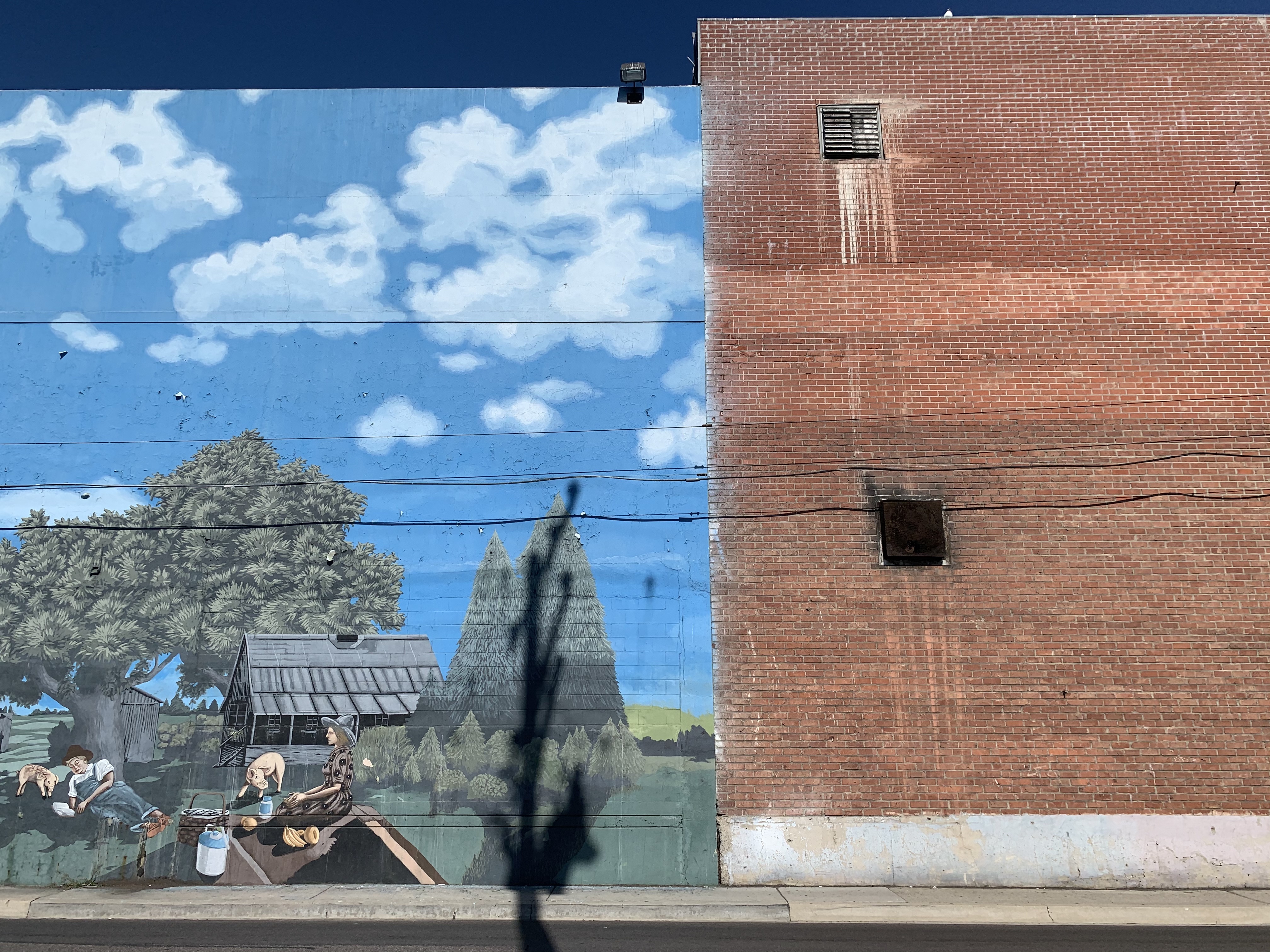
The sun is setting over the idyllic farmland and white picket fences of the mural outside the Farmer John meatpacking plant. Just as the afternoon rush of workers leaving the plant begins, a line of noisy 18-wheelers is rounding the corner, bearing the names of trucking companies in Utah. Each truck is hauling a tall steel trailer with grates in the sides, just wide enough to see the pale, hairy sides and pink snouts of dozens of pigs in very close quarters.
The Farmer John plant is in Vernon, a phantom city of just a few hundred residents but many workers southeast of downtown Los Angeles. Vernon is vital to the food industry— it’s been home to a number of the region’s slaughterhouses, meatpacking plants and importers for more than a century.
The city’s slogan is “exclusively industrial,” and industry has defined its history. As vaccinations ramped up for the city’s workers, it offered a case study in both the many-layered perils of the industry and the achievements in delivering a measure of workplace safety for essential workers during the pandemic.
The sources of COVID-19 infections in Vernon’s workers have been difficult to track. While workers and plant owners disagree about whether enough was done to protect them from infection on the job, they concur that Los Angeles County should have provided vaccination opportunities sooner to the packers, who suffered some of the highest infection rates in the county.
Meatpacking plants across the country have seen mass workplace outbreaks during the pandemic. To make meat affordable, these plants often maximized efficiency by placing workers shoulder to shoulder, working long shifts with little opportunity for social distancing. But as dangerous as the workplace itself can be, many of Vernon’s workers feel most at risk outside of the tiny city, on their commutes or in packed housing.
It's why tracing the source of coronavirus infections proved a difficult if not impossible job. “When employees leave and they carpool together, or they may live in situations where it’s a multi-generational family, or multiple families,” said Fredrick Agyin, who directs Vernon’s small health department. “It’s hard to tell: are they getting COVID from work, or are they getting it from outside work?”
To understand why Vernon struggled in particular with the coronavirus, it’s helpful to understand how it got to be the kind of industry town it is.
As much as it was an agricultural powerhouse that grew into an entertainment capital, the Los Angeles region has also been a major industrial metropolis.
The corridor along the Los Angeles River, which stretches from downtown LA to the ports of Long Beach and San Pedro, remains heavily industrial, and led to environmental disasters and poor health for residents of neighboring communities.
Several “cities” along this corridor were incorporated mainly to carve out space for industry to operate without being hindered by residents or local governments. Cities like Vernon exist in LA County for a very specific reason, said historian and activist David Levitus: “They weren’t made for people to live there. They were just made for factories to exist with as little regulation as possible.”
For years, it was clear Vernon’s city government wasn’t designed for the people who lived or worked there. It was known as among the most corrupt in the region, functioning as a personal enrichment machine for a few officials.
In 2006, the LA Times reported the city was holding unfair local elections that shut out new candidates for public office. That same year, then-mayor Leonis Malburg, who had been in office for more than a half century and was descended from Vernon’s founders, was indicted for voter fraud. He had claimed to live in Vernon while actually maintaining a residence in the ritzy Hancock Park neighborhood in Los Angeles. The city was nearly disincorporated and absorbed into Los Angeles in 2011, with one county supervisor calling it a “company town masquerading as a city.”
Vernon’s industrial landscape doesn’t exist in a vacuum, and its neighbors, cities like Maywood and Huntington Park, are some of the most densely populated in the nation. Vernon continues, however, to have the highest rate of COVID-19 cases of any community in the county, and last summer, the city had as many cases as residents. This is partly due to Vernon’s extremely low permanent population. But the city’s neighboring residential communities also have among the highest rates. The working-class, predominantly Latino cities of Southeast LA, where many of Vernon’s workers live, became the epicenter of the pandemic in the region, driven by higher numbers of essential workers and crowded housing.
In November, Cal-OSHA fined Farmer John for safety violations that caused hundreds of workers to be exposed to COVID-19 at the company’s Vernon plant, which has more than 1,800 employees.
In its running list of workplace outbreaks, LA County continues to include the Farmer John plant, with nearly 800 confirmed cases among staff members, the largest ongoing workplace outbreak in the county. Even with vaccinations, this outbreak is far from over.
John Grant is the president of United Food and Commercial Workers Local 770, the union that represents meatpacking workers at Farmer John and other plants. He said that poor conditions at Farmer John put packers at even higher risk than other essential workers.
“On numerous occasions,” Grant wrote in an email, “the company has failed to enforce safe physical distancing inside the facilities, properly notify employees of COVID exposure, or have adequate protocols for facemasks and other protective equipment that could help to curb the spread.”
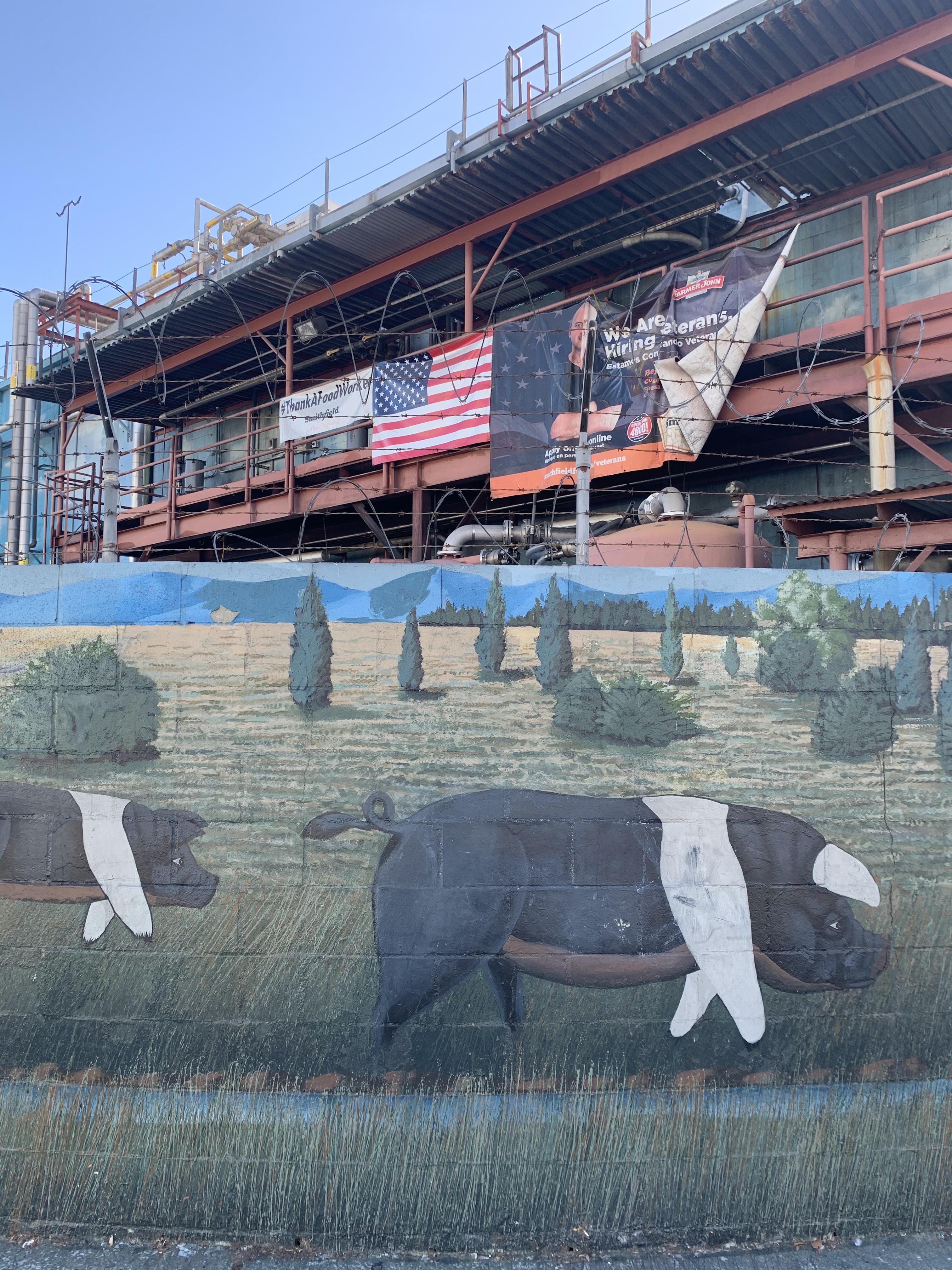
Outside the Farmer John plant at quitting time, workers in face shields, double masks and safety helmets walk to the bus stop or to their cars, a stretch of sidewalk scrawled with messages in chalk like “Go Vegan,” and “Stop Animal Cruelty.” The plant is a frequent site of protests against the meat industry, making some of the workers uneasy.
“Are you a protester?” a security guard asked a reporter standing on the corner.
Arturo Garcia, a worker at Farmer John, said the company took steps – like increasing testing and providing PPE – but worries the virus could still come from outside at any time. A large portion of employees take the bus to work, Garcia pointed out. “We’re all taking risks,” he said.
At a plant as big as Farmer John, some areas are safer and more organized than others, said Maya Barron, a researcher and organizer with UFCW 770. “The situation in Kill is very different from the situation in Pork Cut,” she said, referring to two different sections of the plant.
Even before the pandemic, the plant could be an unsafe place to work, with the threats of repetitive stress and heavy machinery.
“We were advocating really hard to have food workers be actually earlier in the phased rollout,” Barron said, referring to state rules for vaccine eligibility.
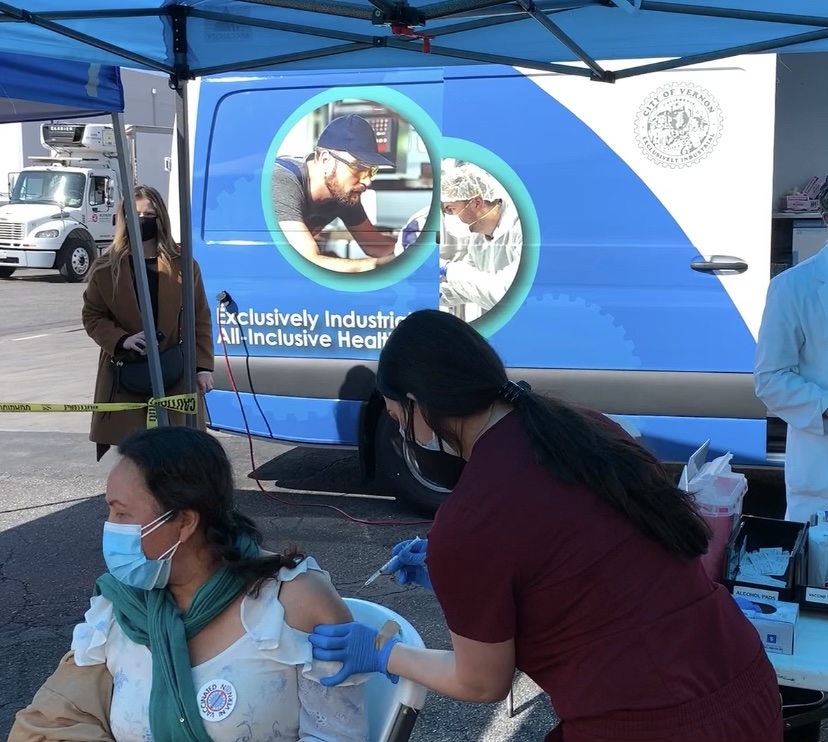
Vaccinations first became available to food workers in LA County on March 2, and Vernon invested in a mobile vaccination unit that travels to the city’s many meatpacking plants and other workplaces to easily administer as many doses as possible to workers. Barron said UFCW was instrumental in advocating for this project.
By March 17, a mass vaccination site was in full swing at Rose and Shore, a meatpacking plant that supplies prepared food to airlines and supermarkets. Rosa Hernandez, a packer in the plant, said she was relieved to finally get vaccinated at work. Now, she said, “We have a hope that everything will go back to normal like before.”
Hernandez is among the 300 workers at Rose and Shore who were vaccinated within a few hours at the plant using the city’s mobile vaccination unit, which then moved to two other workplaces on the same day. Vernon’s mayor, Leticia Lopez, attended the Rose and Shore vaccination site, along with a number of other city officials and a significant media presence.
Angela Kimmey, who works in the city administrator’s office, said the city is hoping media coverage of the mobile vaccine unit will help alleviate some of the negative press Vernon received for its many outbreaks during the pandemic.
“We feel that this is a really efficient and effective way to vaccinate large groups of people at once,” Kimmey said. “We feel like it’s a really proactive way to get lifesaving vaccine out into the public.”
Lopez and others echoed this sentiment, saying the workplace vaccination site was a perfect fit for Vernon’s workers. Without having to miss a day of work, packing workers are ensured appointments to get the first and second doses.
“Most of these employees reside in the Southeast Los Angeles area, and that’s the hardest hit area when it comes to COVID-19,” Lopez said. “A lot of them do struggle with trying to get online, trying to schedule a vaccine, so this really allows them to be able to just get it at their workplace and it’s seamless, really.”
“It’s well past due,” said Irwin Miller, president of Rose and Shore. “We’re hoping...that we’ll have a more steady, stable workforce,” Miller said, adding that he also hopes the vaccinations will make his workers feel safe again.
Miller said his company’s COVID protocols ensured workers were safe on the job, but couldn’t stop them from bringing the virus in from outside the building’s walls.
“We are actively advocating for more doses,” Kimmey said, “because in probably about 12 days of actual working, delivering vaccines, we’ve already vaccinated almost 3,000 people.”
While the vaccine is now going into workers’ arms at workplaces in Vernon, Agyin said food workers should have been higher on the state's priority list.
“We thought they should have been on a higher par with even the nurses, and I still believe that,” he said. “Without food, there’s no doctors, there’s no nurses, there’s no hospitals.”
Agyin defended Vernon’s record in confronting the virus, arguing the city and its largest employers have been trying to keep up with safety measures as much as possible.
“There was a lot of scrutiny on the city,” said Fred MacFarlane, a spokesman for Vernon. Since the city doesn’t have many residents, the health department tried to raise awareness with workers by distributing pamphlets about their living situations in nearby cities.
“The information on being safe at home touched on things like making sure that you’re not having big family gatherings,” MacFarlane said, “but that’s difficult to do if you’ve got a multi-generational family and a dwelling unit that’s small.”
Vernon’s unique position shows how difficult the virus has been to pin down in general, and how little certainty essential workers have about their own wellbeing.
Mo Diaz, a security guard outside of the Farmer John plant, said working at the plant feels safe, for the most part – at least for the security team. “There’s sanitizer every five inches,” she said, adding she’s grateful for the workplace testing.
But often, it’s outside the plants where workers’ safety gets more difficult to track.
Imad Wahba, who manages the Green Olive restaurant just across the street, is concerned about his health and the health of his employees. The restaurant is frequented by workers from the Farmer John plant. Wahba recently recovered from COVID, which he called a “brutal” experience.
“I tried to trace it down,” Wahba said. “it was almost impossible.”