By Ajay Orona
Jonathan Bezjian wants to leave behind a legacy as one of the world’s greatest pound-for-pound fighters.
A 30-year old Armenian American from Hollywood, Bezjian started training at Hayastan MMA Academy in North Hollywood days after he retired from the United States Army five years ago.
Starting at 9 a.m., Bezjian worked out two to three times a day to train for upcoming fights. Often, this training would last until nearly midnight; Bezjian would then close up the gym, mop the mats, shower and climb a flight of stairs to his bed. The gym was—and still is—his home.
In the nine weeks leading up to a fight, each day can be similar to the last one, like a gladiator’s version of Groundhog Day. That all changes when he steps into the cage to do battle.
For some people, this might sound like hell. But for Bezjian, it was a dream he literally fought for. After winning his first two amateur fights—one by knockout, the other a technical knockout—he was poised to turn professional this year. With one more cage victory, perhaps just a well-placed punch would get him there.
But without fights to win, there was nowhere to release this energy—except to redirect it back into his training.
As his big moment approached, Lights Out Xtreme Fighting, a mixed martial arts promotion in Southern California, announced that Bezjian’s potentially life-changing fight was postponed. Then all fights were cancelled entirely, and indefinitely. The COVID-19 pandemic had knocked Bezjian’s entire sport out of commission.
“It was extremely frustrating. Here I am trying to move my career forward and right in the middle of my training, my fight gets canceled,” he explains.
It remains unclear when his career will pick itself back up.
Knocked Down Again
To get his 6-foot-2-inch frame near his maximum competition weight of 155 lbs., Bezjian was just about to eliminate carbs from his diet. In every sense, Bezjian’s mind and body was primed for a payoff. But without fights to win, there was nowhere to release this energy—except to redirect it back into his training.
Another fight was eventually scheduled for May 11, two months into the shutdown, but as Bezjian continued with Hayastan MMA’s intensive fight camp, that match was also canceled.
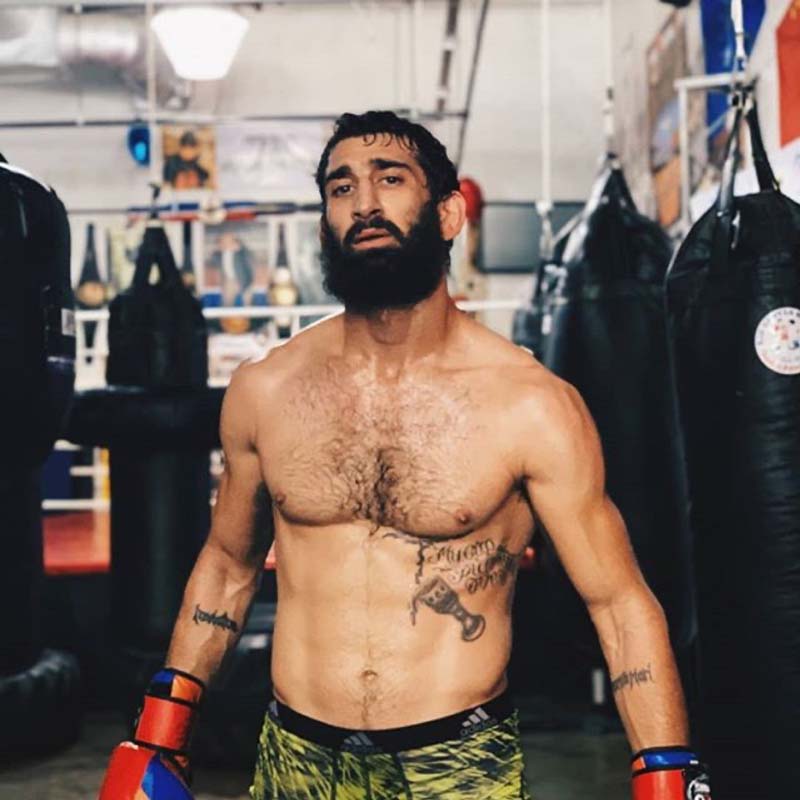
Jonathan Bezjian won both of his fights with relentless striking. Photo Courtesy of Jonathan Bezjian
In the next three months before our interview, Bezjian hadn’t been rescheduled. He’s watched achingly as elite MMA promotions, such as the Ultimate Fighting Championship and Bellator MMA, have started hosting live events again in Las Vegas, with fighters who already made it to the pros.
Bezjian took another blow in recent months. He didn’t just see his future profession sidelined, he also lost his job. Bezjian was working as a bodyguard for executives at the World Surf League, but who needs a bodyguard while working over Zoom?
A combination of living at Hayastan MMA and offering personal training for clients helped Bezjian stay afloat, and a month later, he landed a security gig with Iris Lab Solutions, a company specializing in hand sanitizers and disinfectants.
The Soul of Wrestling
For Armenians, wrestling is no obscure sport. It is intricately entwined with their culture, one with heavy psychological, emotional and financial significance. It is true in Armenia and throughout a global diaspora. It is especially true in Glendale, which houses the largest number of Armenians outside of the former Soviet Union.
“Armenians share a history of pain and survival,” Bezjian says of the displacement that resulted from the Turkish genocide of Armenians and the many challenges that followed, “and grappling is a way that we can express that part of ourselves.”
“Being able to wrestle gives our people hope, especially in trying times,” he says. “Just last year an Armenian father took his son to watch me compete in a match. Afterward, the son wanted to meet me. It nearly made me cry because this kid was looking at me as if I was a hero.”
“But,” he adds, “right now, we’re told we can’t have this part of our culture.”
Wrestling has deep roots for Armenians, whose early ancestors grabbed, pushed, spun and threw each other in organized competitions. When Persian forces invaded Armenia in 296 AD, the soldiers witnessed a form of wrestling called kokh, which combined dance and sport, and often took place at weddings, festivals and other social events. (The Brazilian martial art capoeira is similar in some ways.)
In the 17 centuries since, Armenia has evolved into a nation of grapplers, producing some of the world’s finest wrestlers and judokas (judo practitioners). Since Armenia became a sovereign nation in 1991, following the collapse of the Soviet Union, the little landlocked country of fewer than 3 million people has won a total of 14 Olympic medals, eight of them in wrestling.
Pinned Down by Losses
With cases of coronavirus on the rise, the idea of grappling indoors with an opponent might sound to many people like a literal death match.
Bezjian’s former training partners, Gokor Ambaryan and Karen Darabedyan, who both opened their own gyms, are feeling the effects of such concerns.
So instead of demonstrating how to perform seoi nage, a traditional over-the-shoulder Judo throw or a submission lock for his students, Ambaryan arrives at his dojo at 5 a.m. each day and heads to his office. As the owner of Freestyle MMA, he spends 15 hours daily hunched over a keyboard, wrestling with spreadsheets, trying to secure loans and estimating how long his business can last without clients.
Just three years ago, Ambaryan moved from Glendale to Las Vegas to pursue his dream of owning a martial arts gym. His business had just developed a solid clientele and reputation as one of the best dojos in the area. This summer, Ambaryan was going to hire additional staff, but the pandemic changed his plans and just a month ago, he let go of his sole co-trainer.
With cases of coronavirus on the rise, the idea of grappling indoors with an opponent might sound to many people like a literal death match.
Ambaryan, 25, said in a phone conversation that he now finds himself fighting a creeping sense of helplessness. “This is my baby. I’ve put my whole life into it,” he said. “Whether it stays or goes, it’s always going to feel like my baby.”
Darabedyan, the owner of KD MMA, which he named after himself, runs the numbers and estimates that his business has about two more months before it folds.
It is difficult to foresee when the state will allow such establishments to open and the public will feel safe enough to return to such gyms, so they can’t even begin to guess how long they need to hold out.
But for now, a man like Darabedyan, who began training in judo as a pre-teen, can’t help but think about his young and not-so-young fighters. Some, like Liudvik Sholinian, were about to enter the UFC.
“You’ve spent your whole life trying to build something, working toward this one goal, and then they just take it away from you,” Darabedyan said. “They take everything away from you, except your rent and mortgage.”
Unlike a white-collar professional, who can transfer their skills from one job to the next, a fighter like Bezjian focuses his life on accomplishing one goal, and suddenly, the whole framework for that goal is shrouded in uncertainty. “I have no back up, no other options. Being a fighter is just who I am; it’s who I was meant to be,” he says. “Either I make it in combat sports or I die trying.”
Grappling in Today’s World
Just months ago, the U.S. Olympic & Paralympic Committee placed wrestling and judo in the worst category for athletes in danger of contracting COVID-19.
The pandemic aside, wrestling has gotten up off the mat before. Seven years ago, the International Olympic Committee voted to take the sport out of the summer games altogether due to low television ratings. After pushback and a long and arduous process, wrestling was reinstated by the IOC for the now-delayed 2020 Summer Games. But the future of the sport remains an open question.
The Japanese sport of Judo, which is popular in Armenia and throughout the diaspora, is also having a rough time. High-ranking officials and representatives of the sport are scrambling to come up with and introduce rules and regulations to protect competitors from COVID-19.
Gary Goltz, the former president of Southern California's Judo Black Belt federation Nanka Judo Yudanshakai and the United States Judo Association, summed up the situation: "I think we're sunk."
Goltz said if Judo were ever to return as a popular activity within this country, it’s a long way off.
Ticking Clock
Inside Hayastan MMA one recent evening, it felt almost as if there is no pandemic. The dojo contains amateur and professional fighters, and others in kickboxing classes or just working out—at a distance. The gym is doing better materially than many others.
“So far, the worst part for Hayastan MMA is not economical, it’s psychological,” said Arthur Chivichyan, the gym owner’s son and lead judo instructor. “A lot of people are already calling us and wanting to come back because the lockdown is making their kids restless.”
And then there are the people who dedicate their lives to the sport. “Our concern is not for our business; it’s for our fighters. The uncertainty they have to struggle with is real.”
To combat this uncertainty, Bezjian still works out every day. He’s also kept his low-carb diet so that he’s in good enough shape to enter a nine-week fight camp—if an invitation to fight arrives. He wants to believe it can come at any moment.
“I know I’m not old, but in the fighting world,”—where the typical fighter retires at 38—“I’m not a spring chicken either. If my name is going to be known, it needs to be known now,” said Bezjian. “The clock is ticking.”
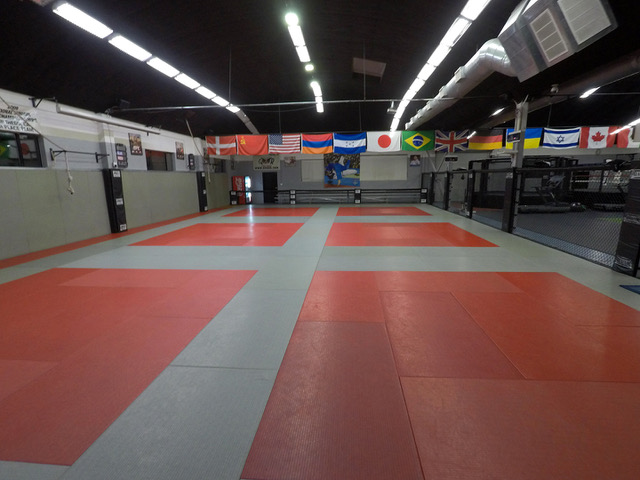
Listen to grapplers training at Hayastan MMA Academy. Photo Courtesy of Arthur Chivichyan