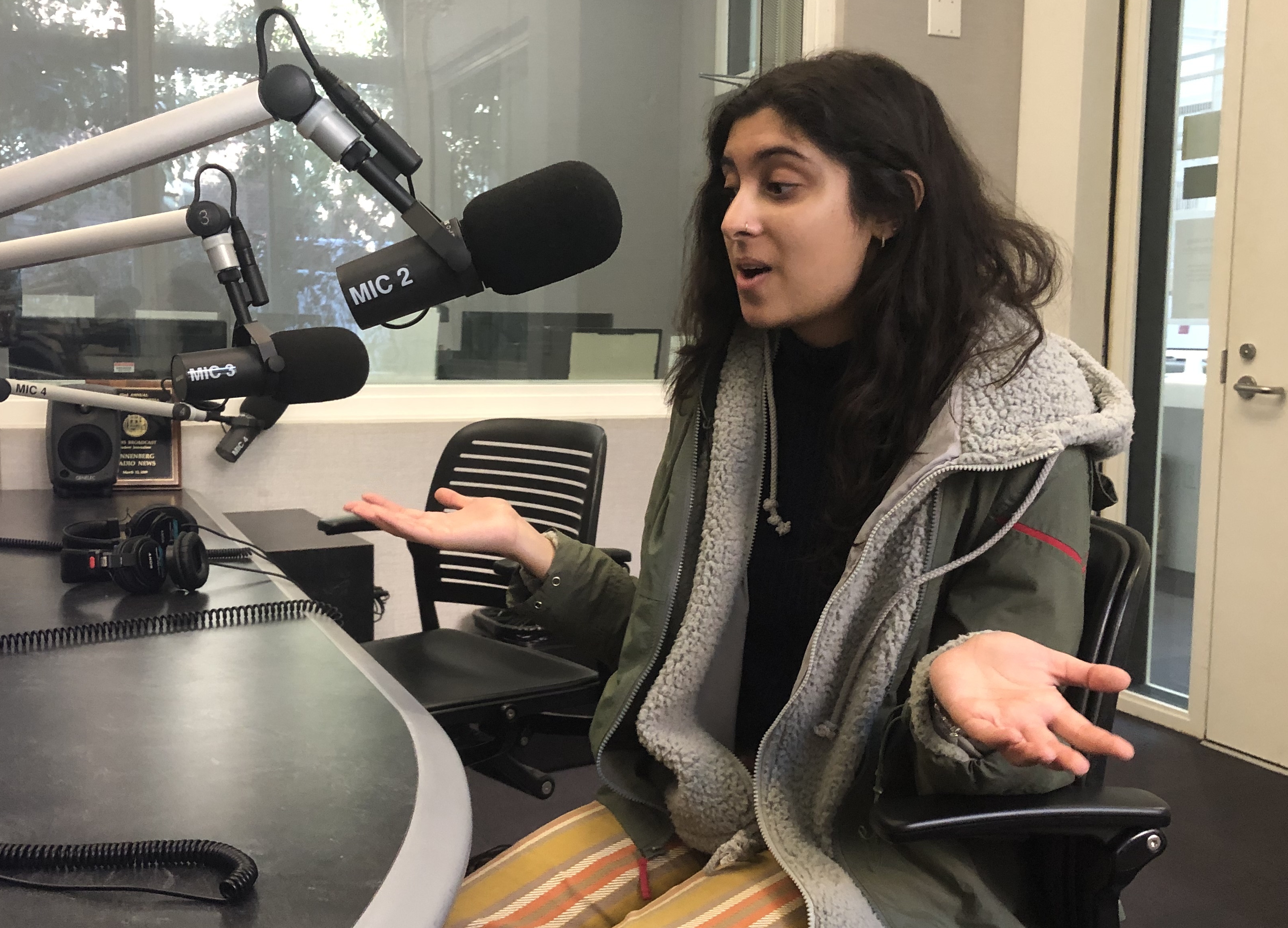
USC, like many universities, focuses their phone solicitations on alumni engagement
Matt Kreiser
Across the country college students make thousands of fundraising phone calls each day from their university’s call center. But the practice often raises only a small amount and some schools are even losing money.
At USC, records show, the school brought in just over $600,000 fundraising by phone in 2018. The cost of that telemarketing was more than $640,000, meaning the school lost about $40,000.
Iyoni Rice, USC's director of annual giving acknowledged the shortfall. “It's always our goal to be able to raise enough money to cover the costs,” said Rice.
Lack of profitability aside, the amount is tiny compared to the more than $572 million the school reported fundraising that same year. So what’s the point of fundraising when you spend more than you bring in?
“The alumni participation rate,” said Elle Davidson, a sophomore at USC who is one of dozens of students who works in the school’s fundraising call center.
The term is clunky, but it’s simply the percentage of undergraduate alumni who give to the university each year. That might be insignificant except that it accounts for five percent of the prestigious annual U.S. News and World Report Best Colleges rankings.
Click to view the transcript Davidson uses when talking with USC alumni
Sophomore Elle Davidson shares what it is like to work in USC's fundraising call center
In a hypercompetitive landscape, schools are churning out calls to alumni to try to boost that percentage. Some even lie about it. Earlier this year, the publication removed Cal from the rankings after they were caught inflating their alumni-giving rate from 7.9% to 11.6%. The University of Oklahoma suffered the same consequences for inflating their rate from 9.7% to 14%.
According to Davidson, USC’s alumni participation rate goal is 34%, several times higher than most schools and an indication that USC isn’t letting recent scandals get in the way of its historic fundraising run.
“USC is currently ranked 22nd in the nation, based on the U.S. News World Report, and this ranking is directly based on our alumni-participation rate,” Davidson tells prospective donors over the phone. “It doesn't matter how little or how often you give. Anything that you would choose to give today will go to boost our university ranking. So with that in mind, would you want to give $10 today?”
Davidson said "asks" for money usually start at $50 and go as low as $1 because what matters is the number of donors, not how much is raised.
“What I'm focused on in annual giving is not the amount of money that we raise,” Rice said. “We're more focused on the number of individuals that support the programs they care about at USC. So it's more about the number for us than it is about the amount of money that we're raising.”
Not all schools follow that line of thinking. In 2016, Stanford stopped phone solicitations, citing a “dramatic rise in negative responses to calling.”
“While many of our peer institutions are under pressure to reach ambitious participation goals, we think it's time to acknowledge that these tactics often have a short shelf life and, in the long term, don't cultivate philanthropic behavior,” they wrote at the time.
“I have alum telling me its disrespectful I’m calling because USC gets so much money. 'They don’t need my money. They don’t need you calling,'” Davidson said.
(Photo by Ling Luo)
“The hegemony of third-party rating systems has brought homogeneity to how advancement professionals measure engagement. We've allowed the rankings of certain publications to determine how we measure the depth and breadth of alumni support,” Stanford said at the time.
In a recent MarketWatch article exploring ranking criterion, U.S. News and World Report defended the alumni participation rate as a metric, calling it a “fraction of the weight" the company gives to measure outcomes.
“The donation rate is meant to serve as an indirect measure of graduates’ satisfaction and engagement with their schools,” wrote Robert Morse, the chief data strategist at U.S. News.
Watch to learn how to review the financials of a non-profit like USC
USC, for its part, defended phone soliciting as a valuable component of alumni engagement.
“Many alumni still are very interested in receiving the phone call over anything else because they want to talk to students,” Rice said. “For us, unlike Stanford, we actually find it to be very positive.”
However, she also acknowledged that recent scandals have made fundraising more challenging.
“We did hear concerns from alums who said, you know, ‘I really would like to wait and see how the university will address concerns,’” Rice said.
Mickey Munley, a consultant in higher education fundraising said it is not uncommon for universities to lose money on their phone solicitation operation.
“It really depends on the specific strategy that a university or a nonprofit is deploying," Munley said. “The theory of course is that if it costs me $50 to acquire you as a donor and you make a $40 gift, I've lost $10. But if you then over the next five years, make five more gifts of $40, you've made $240 worth of gifts. I've earned $190 as a return.”
But records show USC usually takes in about $1 million in phone solicitations each year, raising questions about the retention rate and acquisition of new donors. However, what Munley finds most concerning about a university like USC is the lack of money coming from small donors.
“It used to be that 85 percent of your donors would give 15 percent of the dollars and the inverse of that, 15 percent of the donors would give 85 percent of the dollars. Then it was 90-10. Then 93-7. And now it’s 95-5 and maybe even worse,” Munley said. “Clearly where things are at right now, that’s not a sustainable nor responsible model.”
When asked, USC declined to release data on how much they raise from small donors.
“We don’t measure that,” said Sam Lopez, USC’s vice president of advancement communications, when asked about the total amount fundraised through the school’s annual giving department, which oversees donations under $25,000.
“We’re interested in increasing engagement among alumni. The dollar amount is secondary,” Lopez said, reiterating Rice.
Rice did not respond to a request for the historic trajectory of USC’s alumni giving rate, but did reveal that the school’s 2018 alumni giving rate was 37 percent, meaning that more than one in three alumni made a donation to the school that year.
In 2017, that same rate was a whopping 42 percent, the highest of any university its size.