Female concert photographers in an insecure workplace endure harassment and worse as they capture the scene.

By Haley Bosselman

When Kaitlyn Johnston was 17 years old, she booked her first big job as a concert photographer. Johnston first picked up a camera at age 8, so this was a proud moment. Just before the show, Johnston was taking photos from backstage. A member of the well-known 1970s-era hair band, who she won’t identify due to a non-disclosure agreement, paused in front of her before walking out on stage. He asked her a question that shook her: “Who did you fuck to get this job?”

Johnston was on the verge of tears. The band’s tour manager heard the misogynistic remark and assured Johnston that she was hired for the quality of her portfolio. He even yelled at the rockstar and made him apologize to Johnston.

Encounters like Johnston’s are plentiful among women in concert photography. The profession is characterized by a non-traditional and often insecure work environment—usually dominated by men—that often leaves female music photographers vulnerable to abuse.

The Gender Gap

Part of the problem may be that there just aren’t enough women. The music industry is 70 percent male, according to non-profit organization Women in Music. The typical photographer is a 41-year-old white man, according to Data USA.

Boston Schulz, a Los Angeles-based photographer who occasionally shoots in New York, has been doing concert photography for six years. Out of hundreds of shows, she has been in one all-female photo pit.

“I was just shocked, blown away that this was actually happening to me because there were three of us,” she says. “And that was it.”

The gender gap is compounded by the unruliness of live music events. Despite the joy that often permeates concerts, each night requires a careful eye on the crowd, according to Emily McArthur, a security guard at The National, a 1,500-capacity venue in Richmond, Virginia.

People cluster together, often in dark, packed spaces, dancing to loud music. Alcohol and drugs are often in the mix. There are fights. In such an environment, McArthur notes, there are “a lot of men creeping on women and grabbing them.”

“We see a lot of crazy things go down,” she says.

In her study of the psychology of sexual harassment, Dr. Shawn Meghan Burn explains that some men use their interpretation of traditional gender roles to somehow justify harassing women. Women in traditonally masculinized industries, like music, can be subject to sexual harassment. Female presence threatens the status quo, but sexual harassment reinforces it.

At music festivals, the workplace is further intensified by extreme weather, long days and gargantuan crowds. The employees of these festivals also must coordinate with other staffers they often don’t know and can’t yet trust.

Men dominate the music industry.

Across creative roles in music, women are the minority. From radio to streaming, how does that translate into what we hear from the industry's biggest artists?

Subtle Sexism

Courtney Coles always wanted to shoot the Vans Warped Tour, the annual “misfit summer camp” rock tour that ran from 1995 to 2019. She graduated from college with a bachelor’s degree in photography in 2014. When offered the job to shoot Warped Tour that summer, Coles was so happy she cried. It was a dream come true, but one interaction with a venue security guard left “a bad taste in [her] mouth.”

Pop punk band State Champs were on Warped Tour that year. The group of 20-somethings are led by singer Derek DiScanio’s animated presence and skater boy charm. He jumped into the audience each show. At the Connecticut tour stop, the set proceeded as usual. Kids flew through the air and moshed around. When DiScanio jumped into the crowd, Coles was nearby snapping away. Suddenly, a venue security guard(not affiliated with Warped Tour), violently pulled her arm to get her out of the way of crowd surfers.

“Don’t fucking touch me,” she responded.

As this happened, Coles saw a male photographer in front of her shooting, protected by a circle of security guards. As opposed to the male photographer, who was assisted, Coles’ work was impeded and her personal space was unnecessarily violated. When she demanded an apology, the guard refused.

Research shows gender bias in the perception of faces, according to Dr. DongWon Oh, a postdoctoral research associate at New York University’s psychology department. Oh says his research shows women’s faces come off as less competent. For Coles, that may have meant the security guard believed she was unskilled in navigating the standard chaotic Warped Tour crowd.

Kat Nijmeddin, the creative director for Pure Noise Records, had a run-in with a security guard at an L.A. county venue that mirrors Cole’s experience. Her job involves photographing and videoing all bands from the label, meaning she spends lots of time in turbulent crowds made up of hardcore and pop punk fans. At this metalcore show, a security guard told Nijmeddin she needed to get out of the pit.

“Sweetheart, with shows like these, they get kind of rowdy,” she recalls him telling her.

Never wanting to cause trouble, Nijmeddin exited the pit. The security guard did not let her back in, though she says the other male photographers were allowed to stay.

“I have a lot of male photographer friends. They never have to deal with these issues,” she says. “I'll bring stuff up like this. And they're just like, ‘oh my god, that's so crazy. Like, I can't believe that would happen.’ I'm just like, ‘oh, that doesn't ever happen to you guys like all the time.’”

Ulterior Motives

Like the 10 other photographers interviewed, 29-year-old Los Angeles photographer Danielle Parsons describes problems with security, being assumed she’s a groupie and a good amount of patronization. Parsons began shooting her Pennsylvania hometown music scene as an early teen.

“I just remember being preyed on by older men when I was a teenage girl,” she says. “It was something that had been just kind of socially acceptable, like boys will be boys.”

Early on in high school, Parsons received an instant message on AIM, AOL’s now defunct instant messenger, from an older guy, over 18, in a band from the local scene: “Hey, send me naked pictures.”

Even now, after 15 years in the industry, she still wrestles with such ulterior motives. Parsons recently received an Instagram message complimenting her work from the guitarist of a band she loves. It meant a lot; their music has been meaningful in her life. The guitarist then pivoted the conversation.

“It's insulting when someone slides into your DMs to be like, ‘I love your work,’” Parsons explains. “Then they segue into calling you hot and then it's like, OK, well, now I know what you really meant.”

Numerous photographers, including Parsons, also brought up bands’ tacit “no girls in the van” policies. The idea is that women are too high maintenance for life on the road or that girlfriends would get jealous. But this logic prevents many bands from hiring women to work on tours.

Despite her extensive experience as a photographer, Parsons has only gone on tour with a few bands. She’s “too anxious and paranoid” to elaborate on the frequent instances of being passed over for tour photography jobs.

At 19, Parsons’ then boyfriend would assert, she says, that “they're only having you take pictures because they want to fuck you.”

His jealousy and undermining, on top of the work climate in her chosen field, got into her head. “It's like, ‘Oh, you don't think I'm talented? You just think these guys want to have sex with me.’ That's really great.” As a result, she says, “I almost stopped so many times.”

Parsons started therapy at 18 for depression. However, only now, with the #MeToo movement sparking more discussions about how women are treated in music, has she been able to process the gravity of her encounters with inappropriate men online and in person, her toxic relationship with her boyfriend and the scene’s internalized misogyny.

And for women that experience sexual assault and harassment, it’s hard to move forward. Victims often blame themselves, CarolAnn Peterson says, who specializes in domestic and workplace violence as a social work professor at the University of Southern California. Women are socialized to be polite, as Peterson explains, and have to consider repercussions.

“If they report this, what happens to their career, especially if they are new within an industry,” she says. “What many times women will do is decide: ‘Am I actually going to have to find another career?”
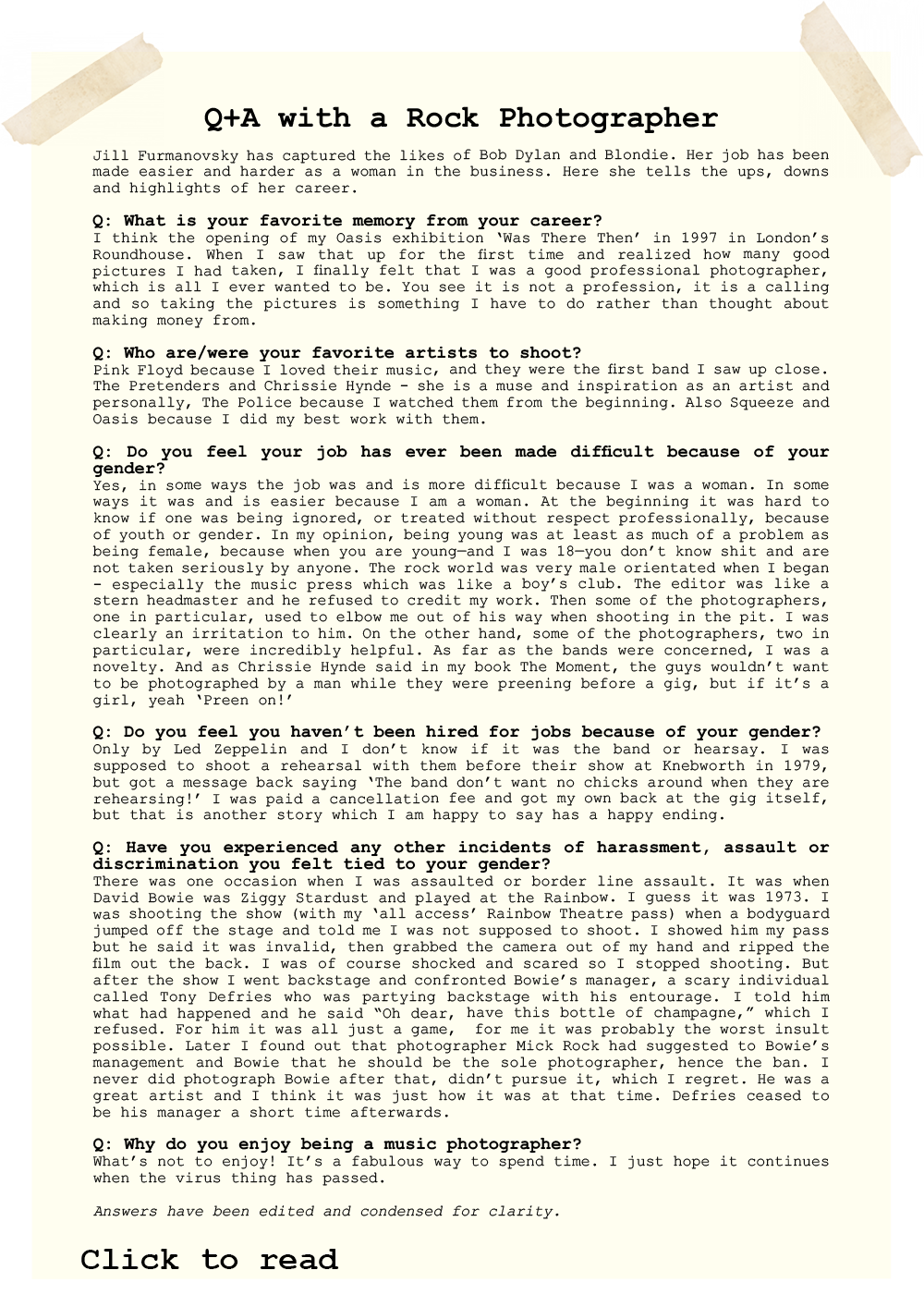
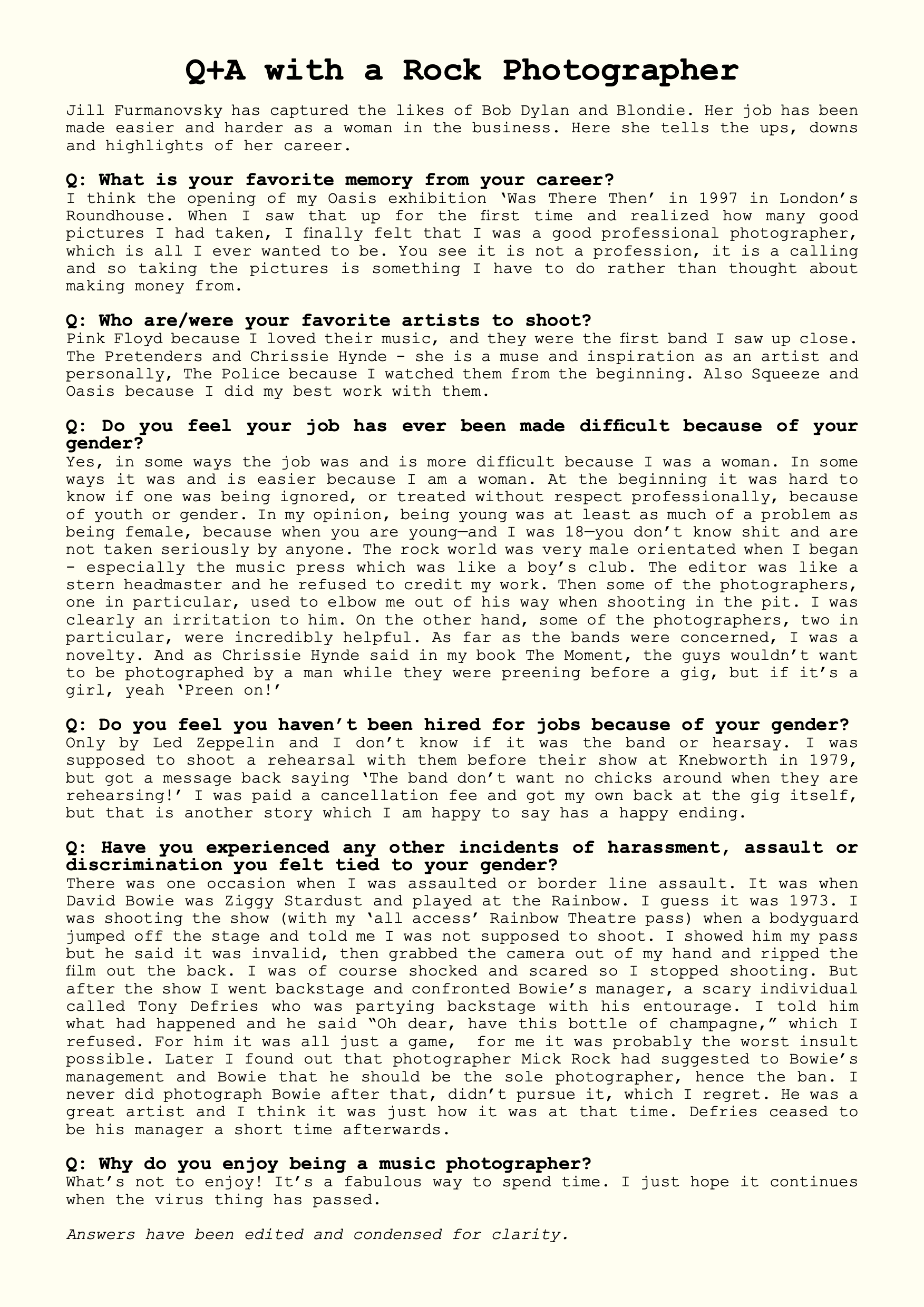
Boston Schulz is a music photgrapher in Los Angeles, Calif. Here she tells how one networking moment took a strange turn.

Photo by Nacho DelaGarza

A Vulnerable Workplace

Live music photographers almost never work in 9-to-5 settings. Many are freelancers, meaning they don’t have any clear pathway to report workplace harassment.

Such problems come in many forms, ranging from microaggressions (such as guys saying women don’t belong on tour) to sexual assault, according to labor and employment lawyer Charles Krugel.

“[Freelancing is] a customer service oriented industry. You’re trying to please a client,” Krugel says. “You don’t want to lose their business, so you might be exposing yourself to a wider spectrum” of inappropriate behavior than people with more meaningful workplace protections.

Aside from sufficient workplace training, Krugel stresses freelancers can make change by standing up for themselves.

Last summer, Johnston was on tour with Indianapolis-based emo rock band Plans. Two weeks in, they played a gig at La Playa, a dingy house venue in Houston, Texas. When Johnston walked into the house with a merchandise bin, she says a venue staffer “grabbed a handful of [her] ass” and then started uncontrollably laughing. Johnston told the band, which is made up of four men, what happened and that she didn’t feel safe. They immediately confronted the staffer.

The guy’s response was mockery. “Why don’t you have pictures of it happening,” she recalls the man saying.

Plans cancelled the show at La Playa and moved to another house venue in the area. The next day, Johnston posted about her experience on Twitter and Facebook, leading to an outpouring of support from the tight-knit DIY community, including several women who quickly came forward with their own stories of assault and theft at La Playa.

It felt like progress. Johnston took the risk of standing up for herself, the band backed her up and social media offered additional evidence, as well as affirmation.

But then someone tagged the owner of La Playa in the Facebook post. The man, according to Johnston, responded by posting hundreds of comments and negative reviews on her professional Facebook page, threatening her professional reputation and safety. To stop the harassment, she blocked him from her page and reported the man to Facebook, filed a police report and threatened to sue him for damages.

Even early on, the incident took a toll. Angry and scared, Johnston left the tour six days early. She needed anxiety medication. Eventually, Johnston ventured out to shoot a few shows and reestablished a comfort level in what she sees as a generally safe and inclusive DIY music scene.

“I can’t let people ruin what I love,” she says.

Like Johnston, other female photographers have found support through social media networks.

One of them is Parsons, the photographer whose confidence was undermined by some men at her work, as well as at home. She remembers getting a message one day a few years ago on Tumblr from a follower: “You seem really sad. I just wanted to let you know you’re a really good role model for girls in the punk community.”

“I started crying,” she says. This time, they were tears of joy.