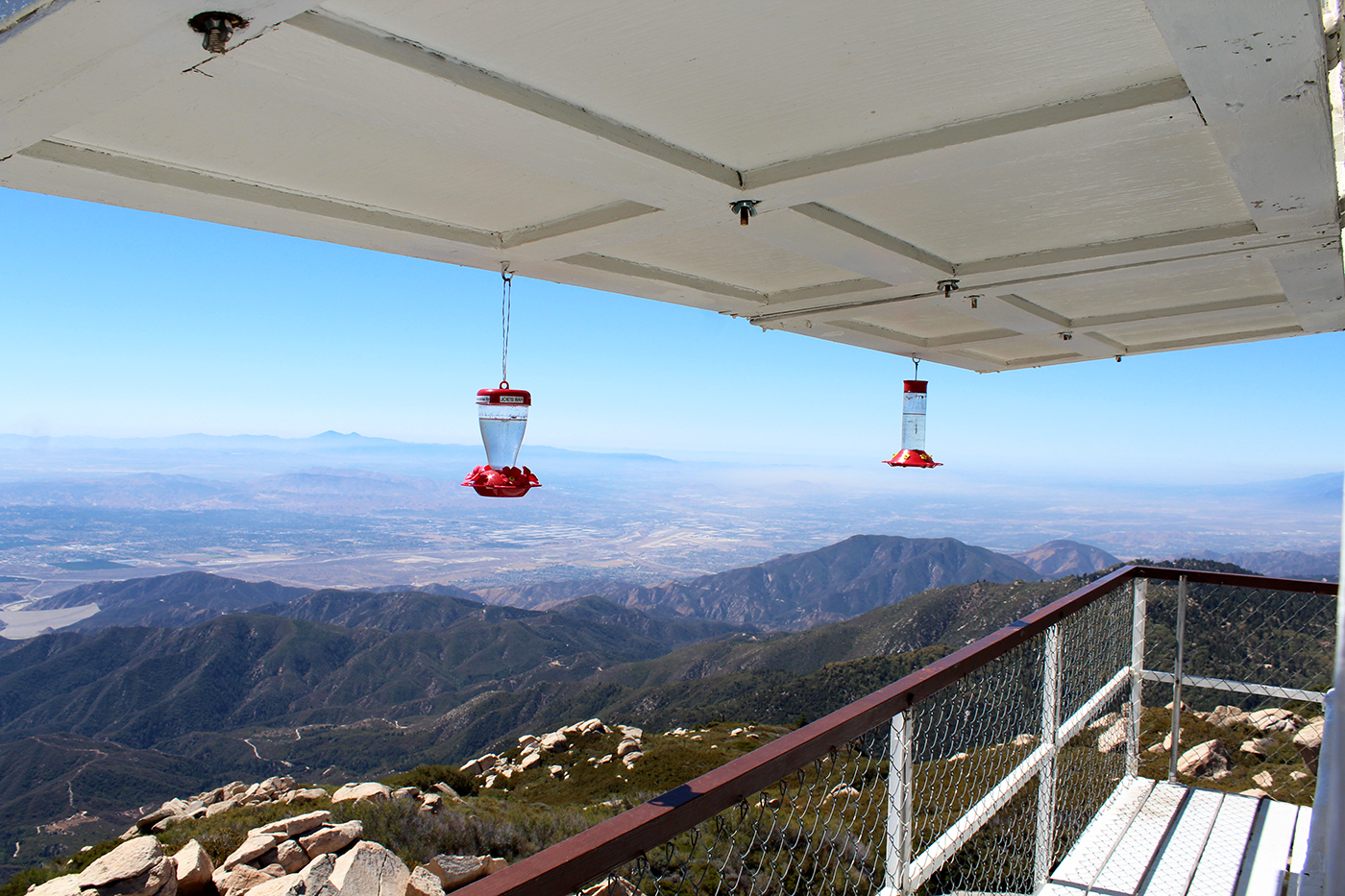
Over seven thousand feet above sea level, the San Bernardino Valley spreads out below.
Ron Wilhelm pointed out the landmarks.
"That's San Bernardino over this is the airport, and those two are Santiago Peak, and Modjeska Peak that make up saddleback."
In our own sense we're protecting our property, we're protecting the forest.
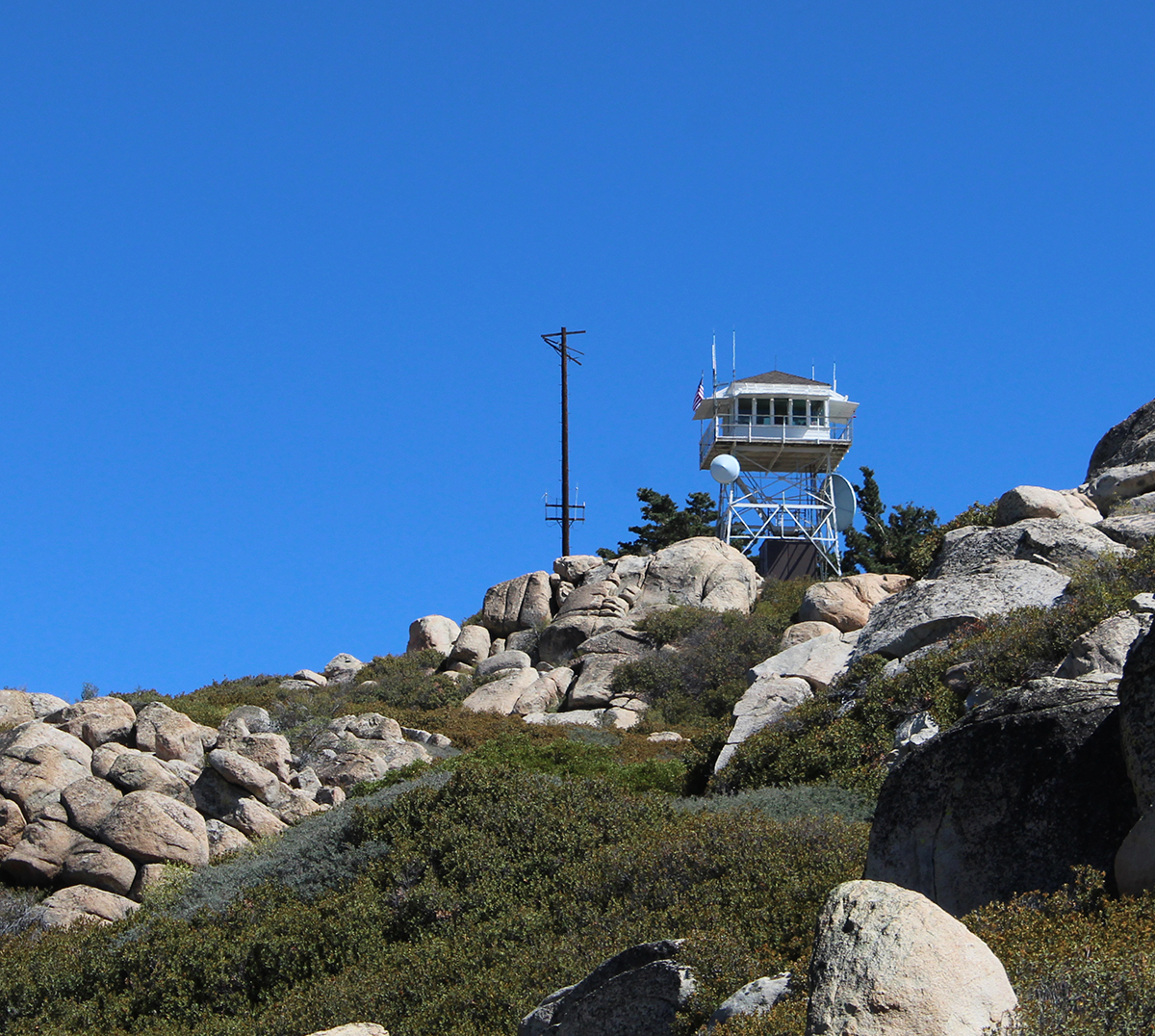
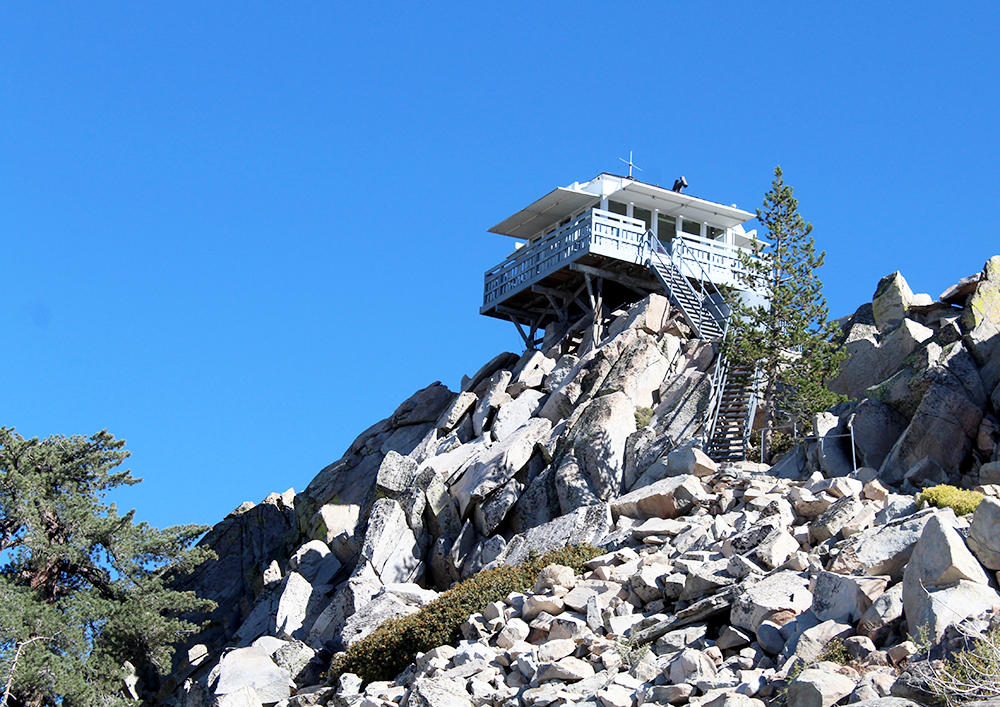
He is 30 feet off the ground on a wooden walk way that wraps around the Strawberry Peak Fire Lookout. The 14 by 14-foot wood building sits on a metal structure that has stood at this location since 1934.
He is part of an organization that helps to keep the forest safe from wildfires, one that is made up entirely of volunteers.
Fueled by a love for the forest and a sense of civic duty these volunteers stay vigilant.
Wilhelm said that it is clearer than it is on most days when the valley is obstructed by a white haze from Los Angeles.
Wilhelm has been a volunteer lookout since 2013 when he moved from Upland to the Lake Arrowhead area. Today he is working the tower with his wife Margarete. They are just two of about 300 volunteers that spend their time working in Fire Lookout Towers in the San Bernardino National Forest.
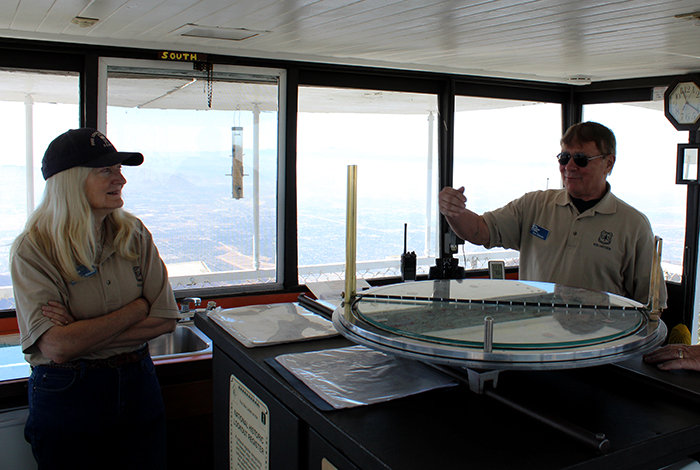 Margarate and Ron Wilhelm in the Strawberry Peak Fire Lookout
"In our own sense we're protecting our property, we're protecting the forest. So, you know in our own small way even though we're amateurs we'e contributing to protecting the mountain," Wilhelm said.
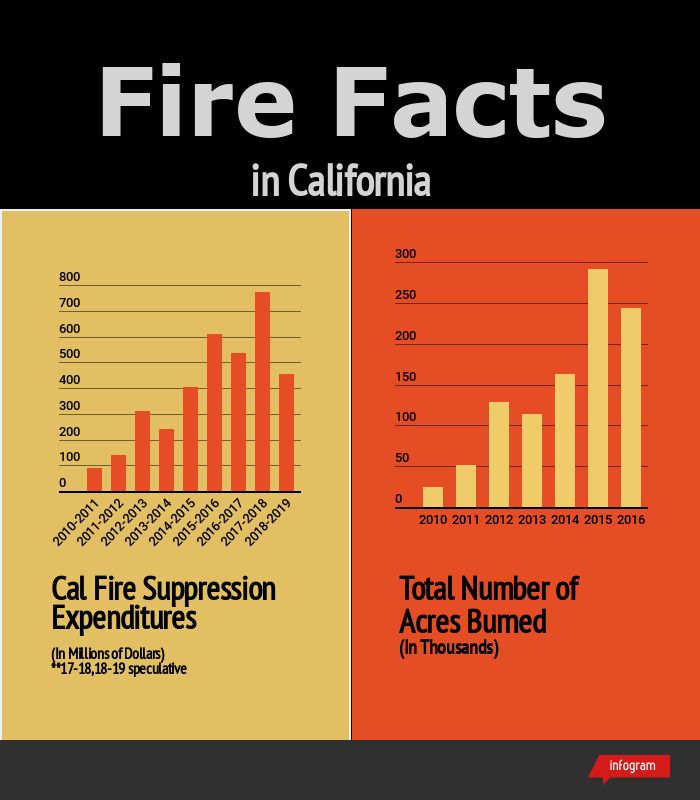
It is incredibly dry this year, so a lookout has to be extra vigilant when they scan the landscape around them. The snowpack in California is well below where it should be, and this has been the trend for nearly a decade. California's drought has hit the San Bernardino National Forest hard. The latest statistics show that Big Bear Lake is down nearly 18 feet from normal levels.
As the land continues to be starved of the water it needs, we have been at an increased risk for fire. Over the last several years, several large fires have ravaged California including the recent Lake Fire in June. With these dry conditions, a large fire is just a spark away.
There are nearly 500 forest service employees in the San Bernardino National Forest during fire season. However, of these employees there are only 18 Fire Prevention Technicians who act as rangers that monitor the forest while driving around to different sites.
Pam Morey, the Fire Lookout Volunteer Coordinator believes that the volunteer program which works in partnership with the U.S. Forest Service can make a real difference and help protect the forest while saving the agency money.
"I like to say that we can stop fires at what I call $100 fires. We see the smoke, they can come in and put it out before it becomes a million-dollar fire," she said.
Zach Behrens the Public Affairs Officer with the San Bernardino National Forest echoed this sentiment, saying there’s always a need for more people monitoring the forest.
"That program [volunteer lookouts] is a really important part of the fire management program," he said.
The Wilhelms have a half shift today that starts at 8:30am and goes until 1pm, but it is not unusual for lookouts in other more remote towers to spend all day at their lookout. The Wilhelms' first duty of the day when they get to the tower is to raise the flag and record the weather to send to headquarters in San Bernardino.
The Wilhelms explain that headquarters want to get readings from all of their towers and stations to get a true understanding of the fire danger in the forest. To do this headquarters needs to record the temperature, humidity, and wind speed.
According to the fire lookouts one of the most common causes of fires are careless campers who don't pay enough attention to their camp fires or are not responsible when barbequing. The lookouts also state that automobiles are also a frequent cause of fires, from overheated breaks to accidently dragging something on the ground.
At one point there were 22 lookouts in the San Bernardino National Forest and 24 in the Angeles National Forest.
However, today there are only seven of these locations in the San Bernardino National Forest. According to Morey most of the towers were destroyed after budget cuts left them abandoned in the late 1970s and early 80s.
San Bernardino National Forest
A plotted map of all seven of the remaining fire look out towers located in the San Bernardino National Forest.
"They were supposed to be destroyed when they shut them down [the forest service] but thank goodness they didn't have the budget to take them down," Morey said. "They closed the doors and walked away. And then you got vandalism and stuff out here in the forest."
She went on to explain that the Angeles National Forest lost all but one of their towers due to natural, and human influences.
"They just let them burn, vandalism. It got so bad that they [The Forest Service] just had to turn them down due to safety," she said.
In 1993 the Southern California Mountains Fountain was formed, it in partnership with the San Bernardino National Forest, merged existing groups to staff volunteers in the towers.
Three of the most prominent towers for the program are Strawberry Peak, (where the Wilhelms are located) Keller Peak, and Butler Peak. All three peaks are within 15 miles from one another but provide unique perspectives on the landscape.
Fernando Delcastillo, a volunteer at the Keller Fire Lookout says, fire towers work best in conjunction with one another when it comes to calling in smoke.
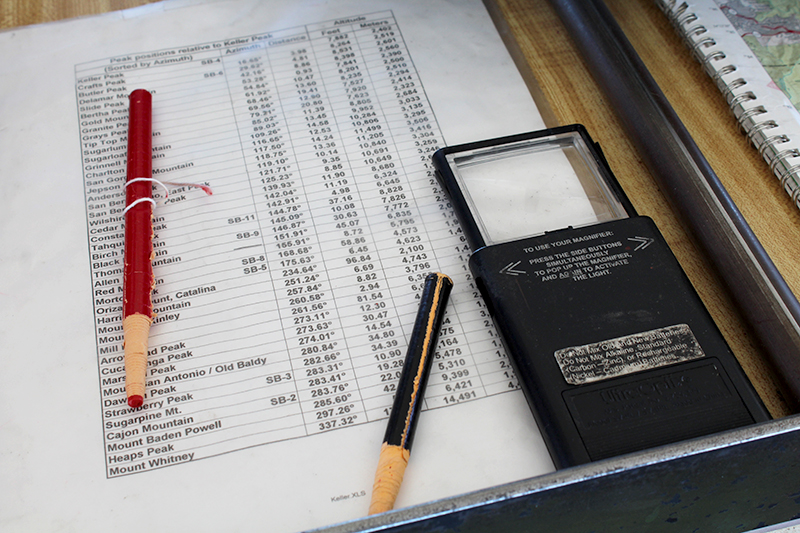
"When you call it in you have to give a distance, a landmark, and an azimuth direction," he said, "If another tower sees smoke they can give their direction and where the two angles meet they triangulate and can actually pinpoint it."
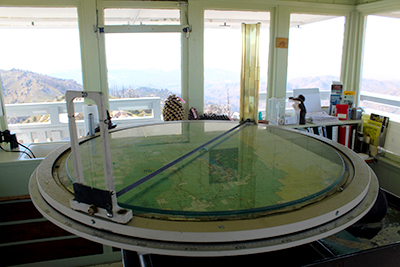 Osborne Fire Finder
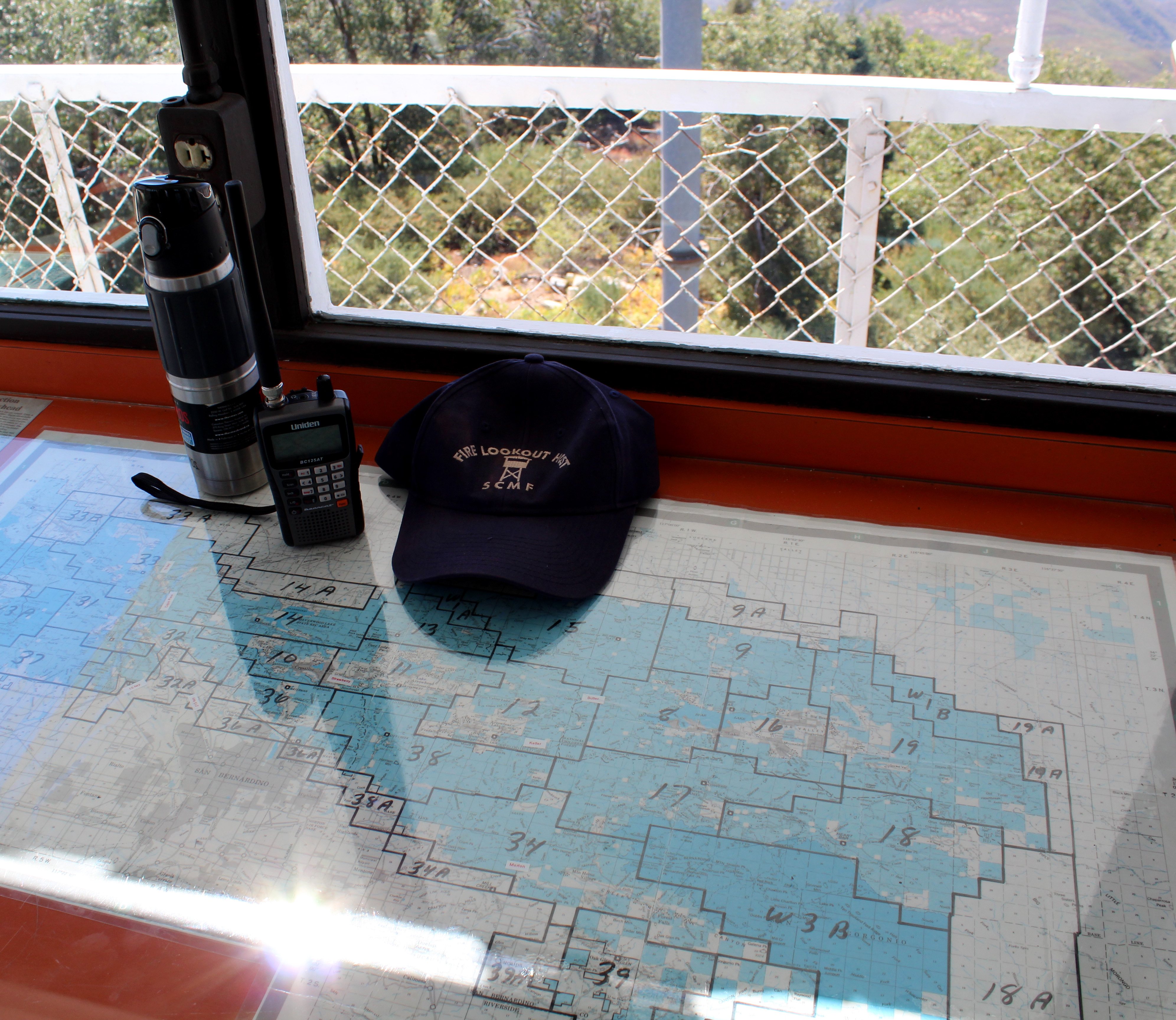
The location is determined by using a device called the Osborne Fire Finder. The device was created in 1915, it uses a view finder, and a topographical map to locate where the smoke is coming from.
After the towers call in a fire, headquarters will dispatch a crew, or a helicopter located nearby to check out the location of the sighting. The lookouts are very conscious of making sure their assessment is correct, to avoid wasting department resources.
The most visually impressive of the fire look outs in the San Bernardino National Forest is Butler Peak Lookout. It sits at 8,537 feet and overlooks a stretch of Highway 18 named "The Arctic Circle" and a portion of Big Bear Lake. It was placed on top of a larger pile of granite in 1936.Climbing the steps and looking out over the side of the lookout is a harrowing experience. Being up this high does expose the volunteers to the elements.
Lighting Strikes are another common cause of a fire and are also one of the most dangerous aspects of being up in a lookout towner. Ed Williams one of the lookout at Butler Peak, once saw 24 lightning strikes in two hours. To ensure complete safety all pieces of furniture are fitted with glass coverings on their legs so that if a tower is struck (even if it is grounded) the volunteer will remain same.
Once a strike has been observed the lookouts must mark it on the Osborne with a grease pencil and monitor the location for at least two weeks. Pam exampled that there is a chance that lightning can cause an underground fire that can smolder, that can flare up creating a larger incident.
Do you have what it takes to become a volunteer lookout?
Pam Morey describes the process of becoming a volunteer lookout reporter Robert Tyler Walker.
The volunteers in the lookouts also act as stewards to the forest. They may greet any visitors who come up to these locations and educating them about fire safety.
"I like meeting the people I mean we've had people from Australia, Japan, Israel," Delcastillo said.
Ron Wilhelm at Strawberry Peak says they can also assist anyone that is injured in the area or provide details to nearby residents when there is concern about a fire. When the Holy Fire was burning during the summer of 2018 in the nearby Cleveland National Forest, the smoke began to travel across the valley.
"We started getting calls from people to the tower saying, 'We see smoke is that local?'," Wilhelm said. "So, what we did is we called dispatch to confirm...We were then able to then report to people that that's drift smoke as far as we know, there's no local fire, but if the situation changes then you should keep checking. I think that's a public service," he said.
Photo Gallery
A collection of photos from the various fire lookout towers in the San Bernardino Nation Forest.
Anyone with enough free time can become a volunteer. There is prerequisite training of course, that consists of three classes, and a day of shadowing in a tower. Volunteers are also required to volunteer for at least a day each month to stay in the program.
Fire lookout towers started appearing all the way back 1930s with the help of the Civilian Conservation Corps. They helped to build 3470 of these towers around the nation with 405 alone being built in California. Their prominence has dwindled, and most that remain are either visitor centers or hip cabins to rent.
While fire lookouts are a product of the distant past and use technology that was implemented nearly 100 years ago they continue to be a vital part of fire management in the San Bernardino Nation Forest.
Zach Behrens of the San Berardino National Forest reiterated the most important thing when it comes to protecting what we have.
"The more eyes we have on the forest the better," Behrens said.