Yiannopoulos identifies much of the movement as “mostly white, mostly male middle- American radicals,” and argues that the movement has no grounding ideology, because, “the pressure to self-censor must be almost overwhelming for straight white men – and, for most of them, it appears to be, which explains why so much of the alt-right operates anonymously.”
Jonathan Greenblatt, CEO of the Anti-Defamation League, does not see the same vague origins.
“White supremacist Richard Spencer runs the National Policy Institute, a tiny white supremacist think tank,” said Greenblatt on his own website, “They coined the term “Alternative Right” as the name for an online publication in 2010.”
With that and other publications, said Greenblatt, Spencer created forums for racists, anti-Semites and others under the banner of the Alt Right, albeit a “tiny one.”
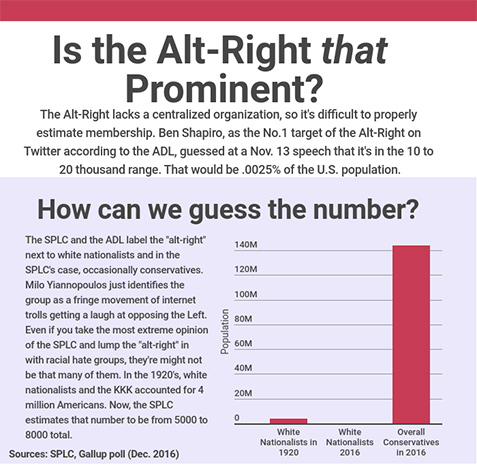
The Southern Poverty Law Center, a liberal legal advocacy group for civil rights, similarly acknowledges the group as a “scrum of white nationalists.”
In an August 2017 article, “The Alt-Right on Campus: What Students Need to Know,” the SPLC offered strategies to resist campus recruitment to the movement, such as protesting in different areas to prevent giving them a platform for their rhetoric. The SPLC frequently receives accusations of conflating the “alt-right” with conservatism, in general. Sen. Rand Paul is currently on their list of neo-Nazi extremists for suggesting that private businesses shouldn’t have to adhere to the Civil Rights Act.
In the same primer, they name Sen. Ted Cruz, former Rep. Michelle Bachmann and former U.N. ambassador John Bolton as associates to the movement’s “brain trust.”
One main figure in this alleged trust is David Horowitz, a current conservative writer who was a once a frequent collaborator with the Black Panther Party in the 1970s. “The white nationalists,” he said, “are a tiny, fringe group with no significant presences, except in left-wing media like CNN, MSNBC, the New York Times and Washington Post.”
While he distances himself from the liberal definitions of the alt-right, he challenges traditional conservatism.
“(Conservatives) don’t even begin to understand,” he said, “the threat this country faces and how to defeat it. We need more aggressive conservatives like Milo (Yiannopoulos).”
Ben Shapiro, editor-in-chief of the Daily Wire with the highest-rated conservative podcast on iTunes, forcefully denounces this notion.
“The Alt-Right simply opposes the Left,” said Shapiro at a Nov. 13 speech at UCLA. “Simply opposing the Left is not conservatism.”
As the No. 1 target of the alt-right on Twitter, according to the ADL, Shapiro also posts videos from his podcast castigating the organizations like the SPLC for its blanket statements against conservatism.
“People on the Left are calling everyone on the right “Alt-Right,” he said in an August 2017 episode, “and everyone a Nazi. That’s absolute garbage.
“(The Alt-Right) believes Western Civilization is an out-growth of white race, and that threats to white race are threats to that civilization. A lot of people believe that the alt-right means that post racist memes online, but the alt-right is grounded in rhetoric from Richard Spencer.”
From liberal organizations such as the ADL to prominent conservative thinkers like Shapiro, the basic understanding of the movement is clear. It’s a far-right ideology anchored in white nationalism that contains marginal membership.
The confusion over the term seems to stem from two sources. First, the mainstream media uses the term as a catch-all for hate groups. Second, organizations such as the SPLC perhaps see Horowitz’s calls for conservative aggression and see all similar strategies as part of the movement.
In a Columbia Journalism Review piece titled, “It is Time to Stop Using the Term Alt Right,” by Shaya Teyefe Mohajer, she lays out all the ways the media normalized white supremacy after the violent protests at Charlottesville.
“After Charlottesville Rally Ends in Violence, Alt-Right Vows to Return” was a Rolling Stone headline.
“The Alt-Right Can’t Disown Charlottesville,” said Ashley Feinberg on Wired.
Mohajer uses several more examples. She reaches this conclusion:
“Can’t we just call a racist a racist? Somehow, they were allowed to rework their public personas to make them sound a little edgy, like an alt-weekly or alt-rock.”
She essentially points to the conflation that the term, by associating white supremacy with the right, softens the actual racism that founders like Spencer demonstrate.
The second confusion is immediately exhibited by the political struggle between two brands of college conservatism in California. In October 2017, College Republicans from across California converged on Anaheim to choose between the two factions Thrive and Rebuild.
“Thrive sees themselves as traditional conservatives,” said Jacob Ellenhorn, former president of the University of Southern California College Republicans. “ Basically, let’s remain in the status quo.
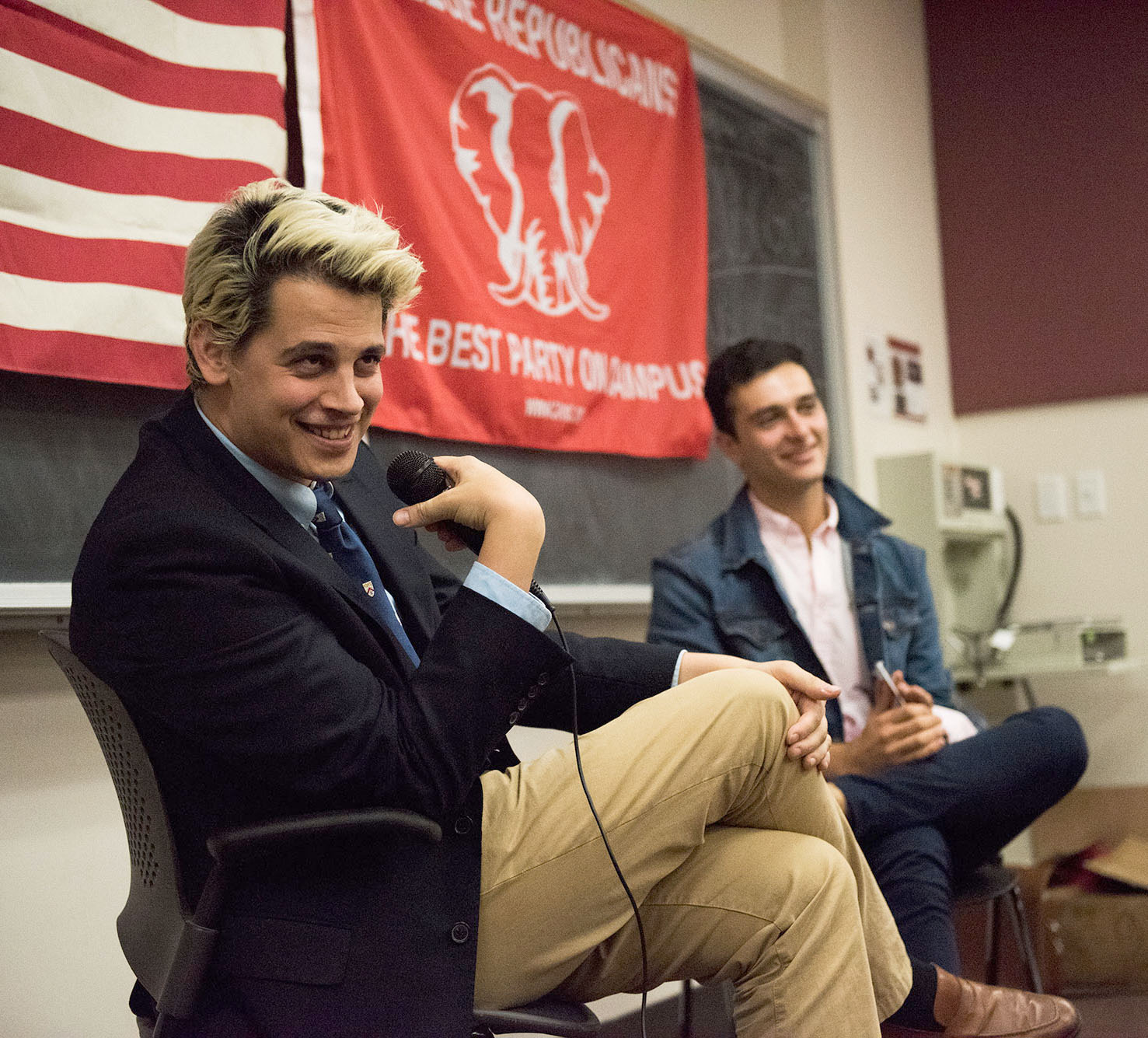
“Rebuild is a grassroots effort that wants to focus on growing membership and hosting conservative speakers, like I did with Milo Yiannopoulos.”
Ellenhorn hosted Milo Yiannopoulos at USC in 2016.
Referencing back to the SPLC primer on the alt-right on college campuses, the article connects Horowitz and Yiannopoulos to “alt-right” recruitment.
“I initially saw the alt-right as a group of working class Americans mad at decades of bad economic policy,” said Ellenhorn. “Now, it’s clear to me that it’s full of the worst types of bigotry, so of course, I don’t associate with them.
“You’ll find that few conservatives do.”
The term still means different things to different people, but more prominence in the mainstream, many sides look to diminish their notoriety through either demonization or disassociation.