LA’s Filipino, Japanese and Russian communities discuss the presidential election
Inflammatory calls to ban all Muslims. Allegations that foreign powers are trying to tip the electoral scale. Polarizing candidates, including a charismatic and erratic political outsider who has harnessed populist anger over immigration.
How are residents in one of the most diverse cities in the country responding to the oddities of the 2016 presidential race? While California as a whole will almost certainly vote blue, views across Los Angeles come as varied as the city itself. But the Filipino, Japanese and Russian communities have special reason to weigh in.
Earlier this year Filipinos, the second largest Asian-American group in Los Angeles, saw their country of origin elect Rodrigo Duterte, a politically incorrect strongman dubbed “the Filipino Donald Trump,” who has raised red flags with his harsh drug-suppression tactics. Japanese-Americans still remember the post-Pearl Harbor hysteria that forced members of their community into wartime internment camps, a hostility echoed in contemporary attitudes toward Muslims. And as ongoing cyberattacks by a Russian hacker upend the Democratic Party and tensions rise in Ukraine, survivors of the former Soviet Union appear both sympathetic to and wary of Trump’s message — or just reluctant to talk.
We interviewed members of these communities to learn what they think about the candidates and the issues at stake in this election.
Hear some of their voices and read about their communities below.
Roll your cursor over the images to listen to the voices of LA voters.
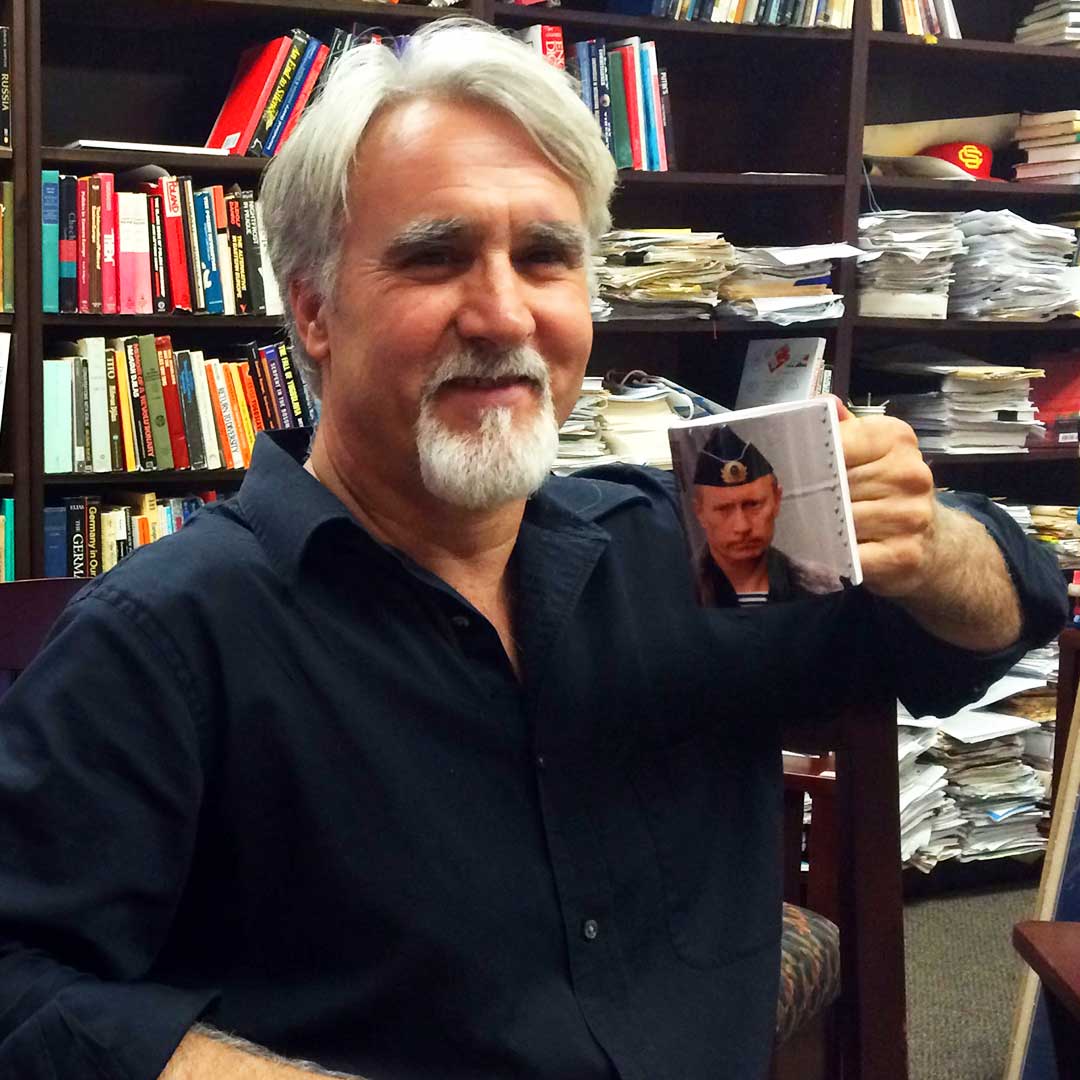
Robert English, USC international relations professor, on the hacking of the DNC databases and what Russia thinks of Trump.
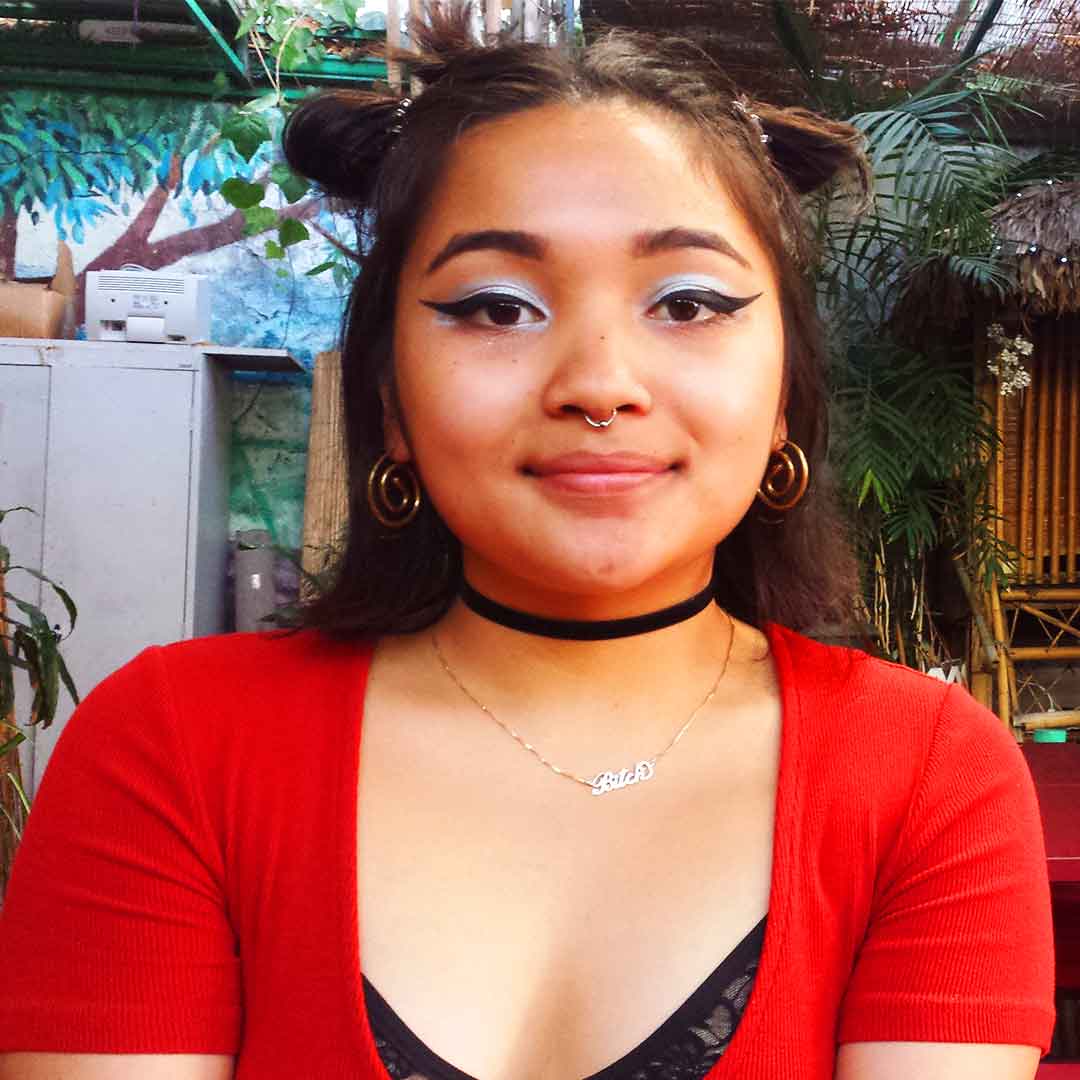
Samantha Agoncillo, UC Berkeley college student, on Trump's hateful rhetoric toward Filipinos and "othered" bodies.
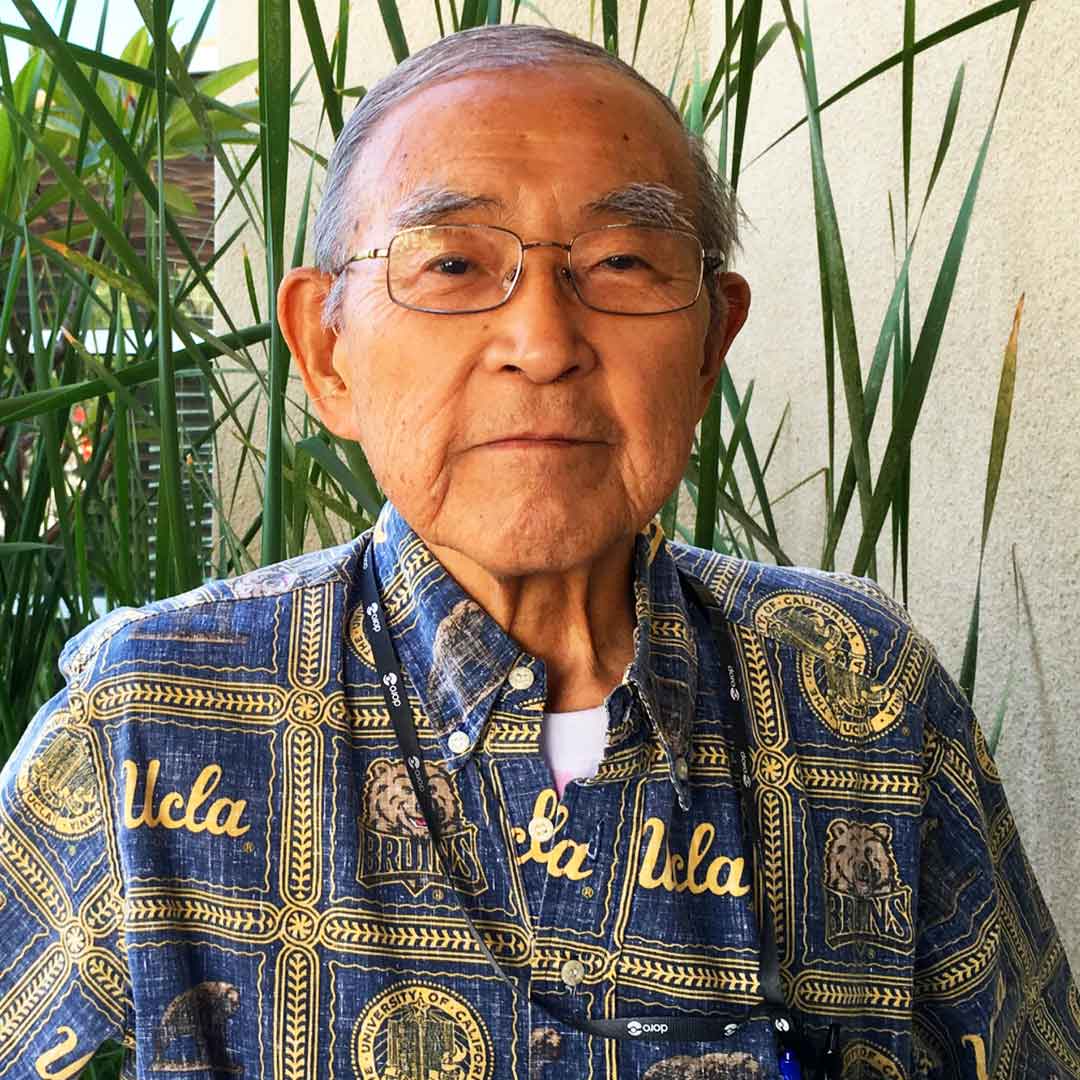
George Wakiji, who was relocated to a World War II Japanese internment camp at age 13, on Trump's proposals for immigrants.
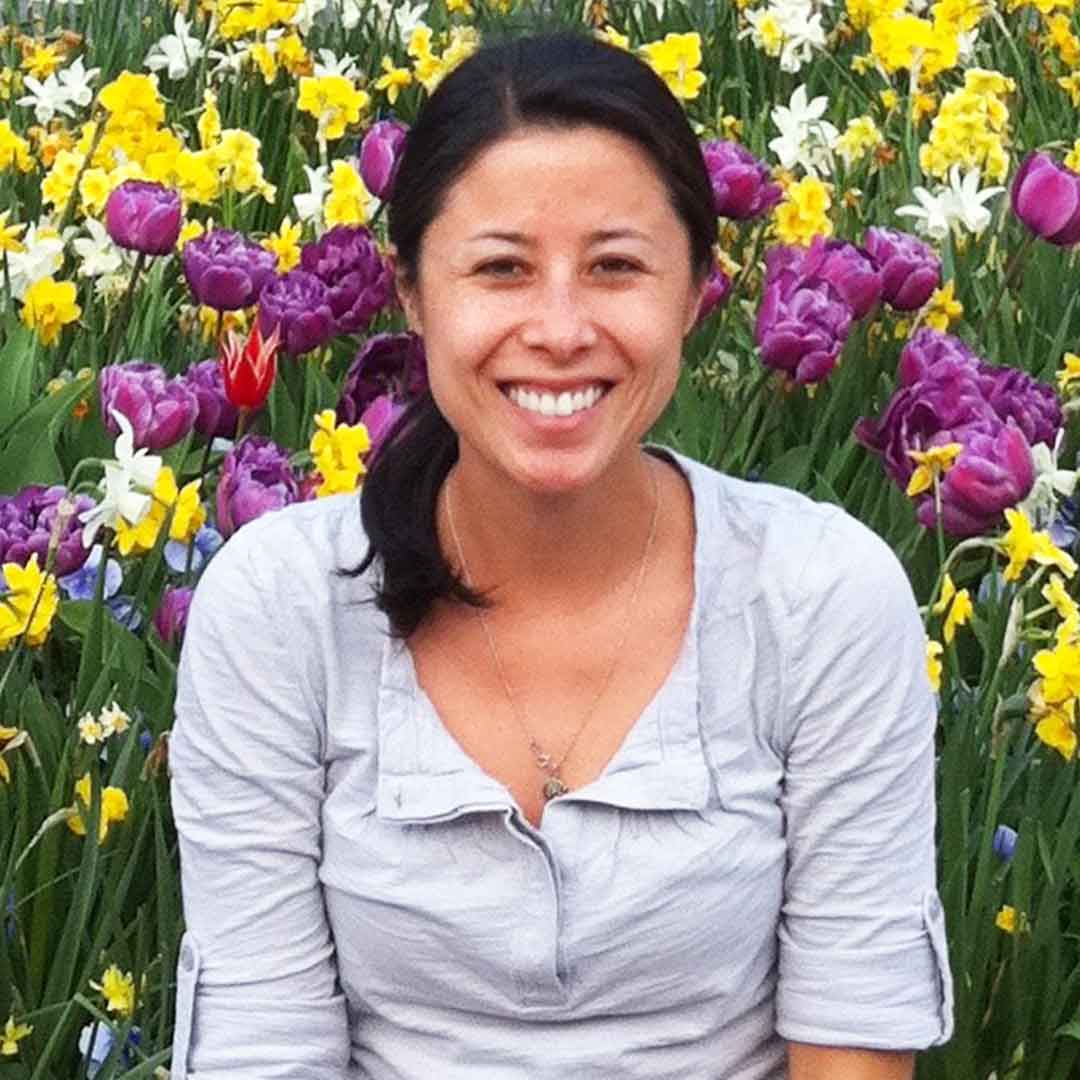
Kristen Marchetti, whose grandparents met in a World War II Japanese internment camp, on the similarities between 1942 and today.
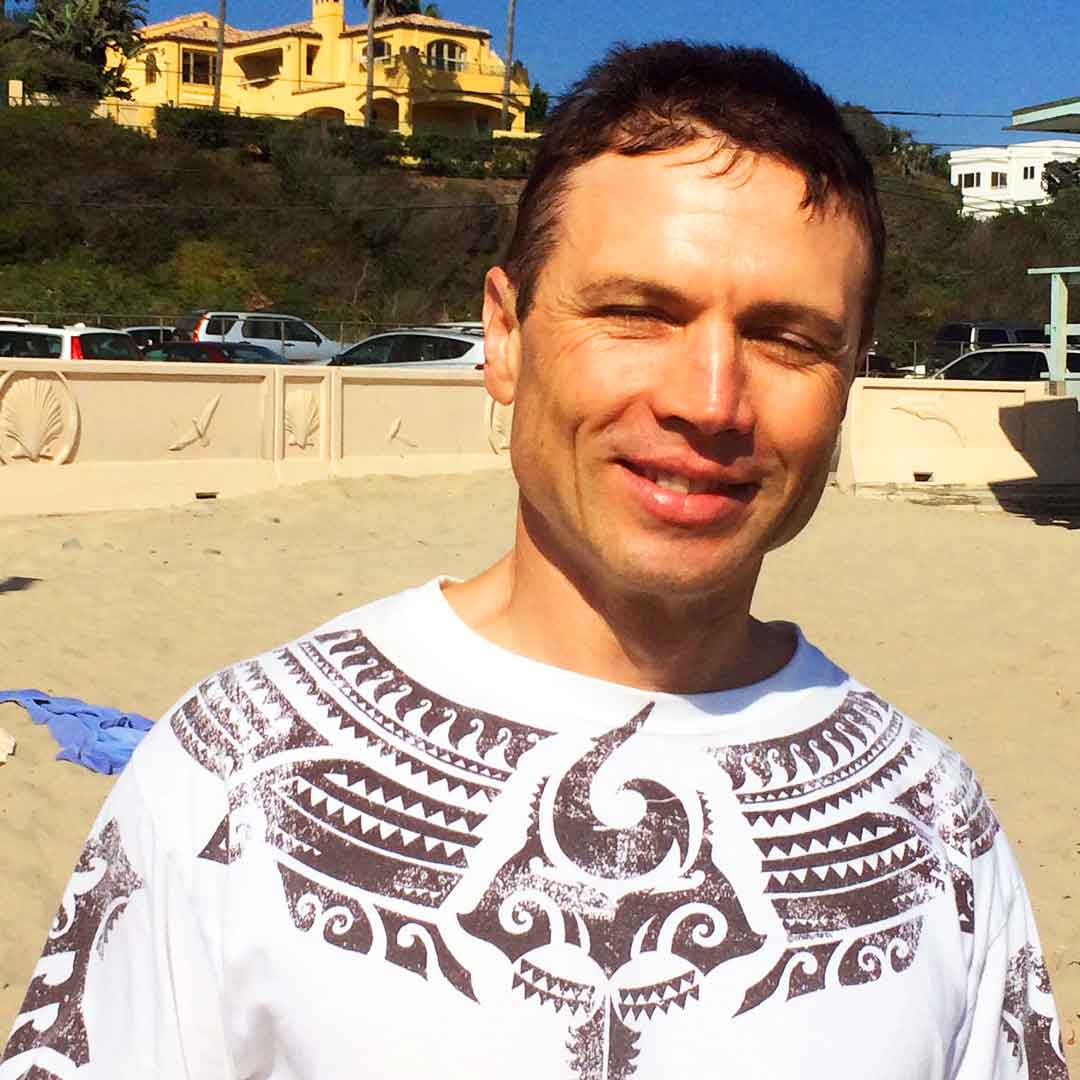
Lenny Levi, a Ukrainian refugee — now an American citizen — on Russians' reluctance to talk to journalists.
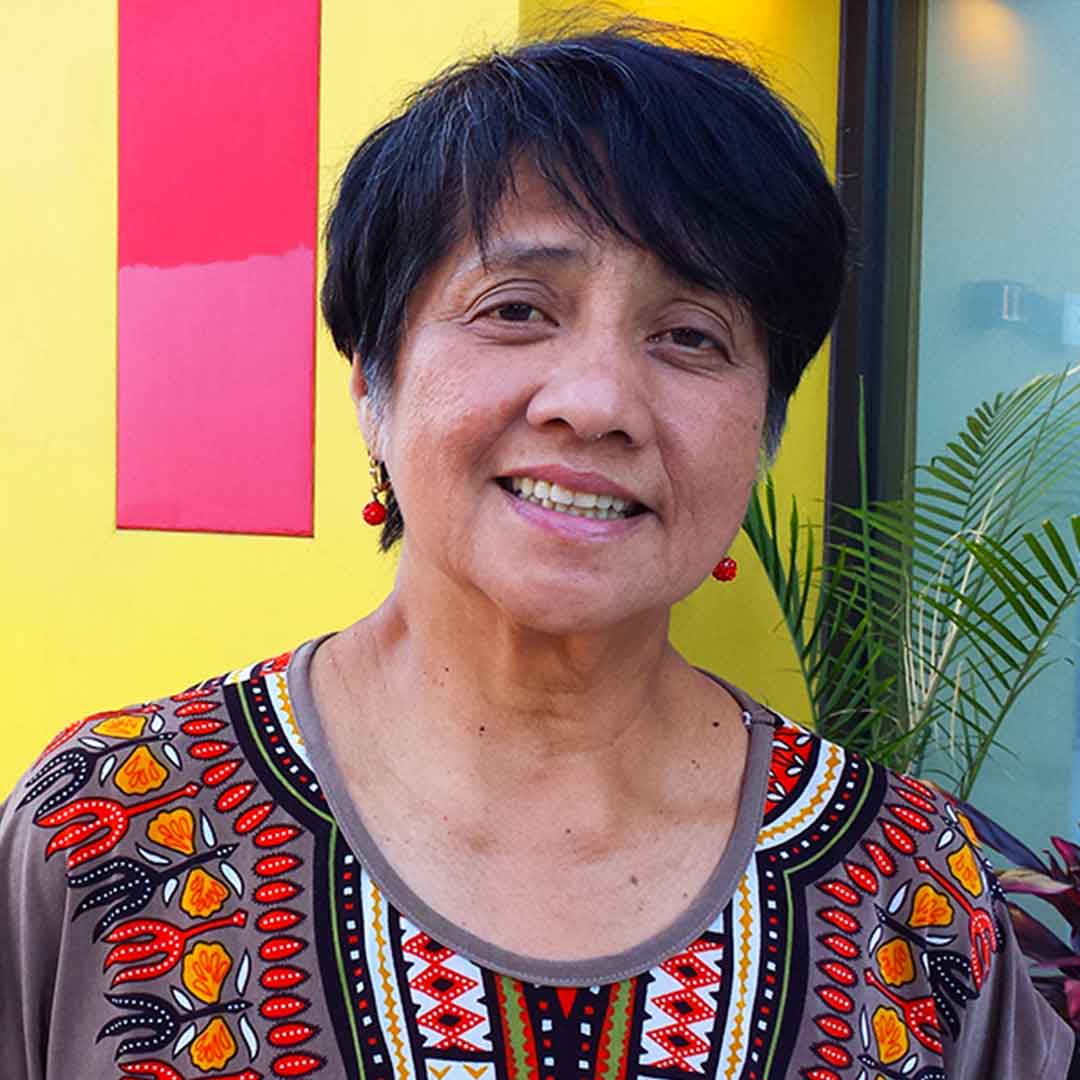
Myrla Baldonado, activist and former prisoner under Philippine martial law, compares Trump to the late dictator Ferdinand Marcos.

An American who has lived in Russia on Russian nationalism and why she doesn't want to talk on the record.
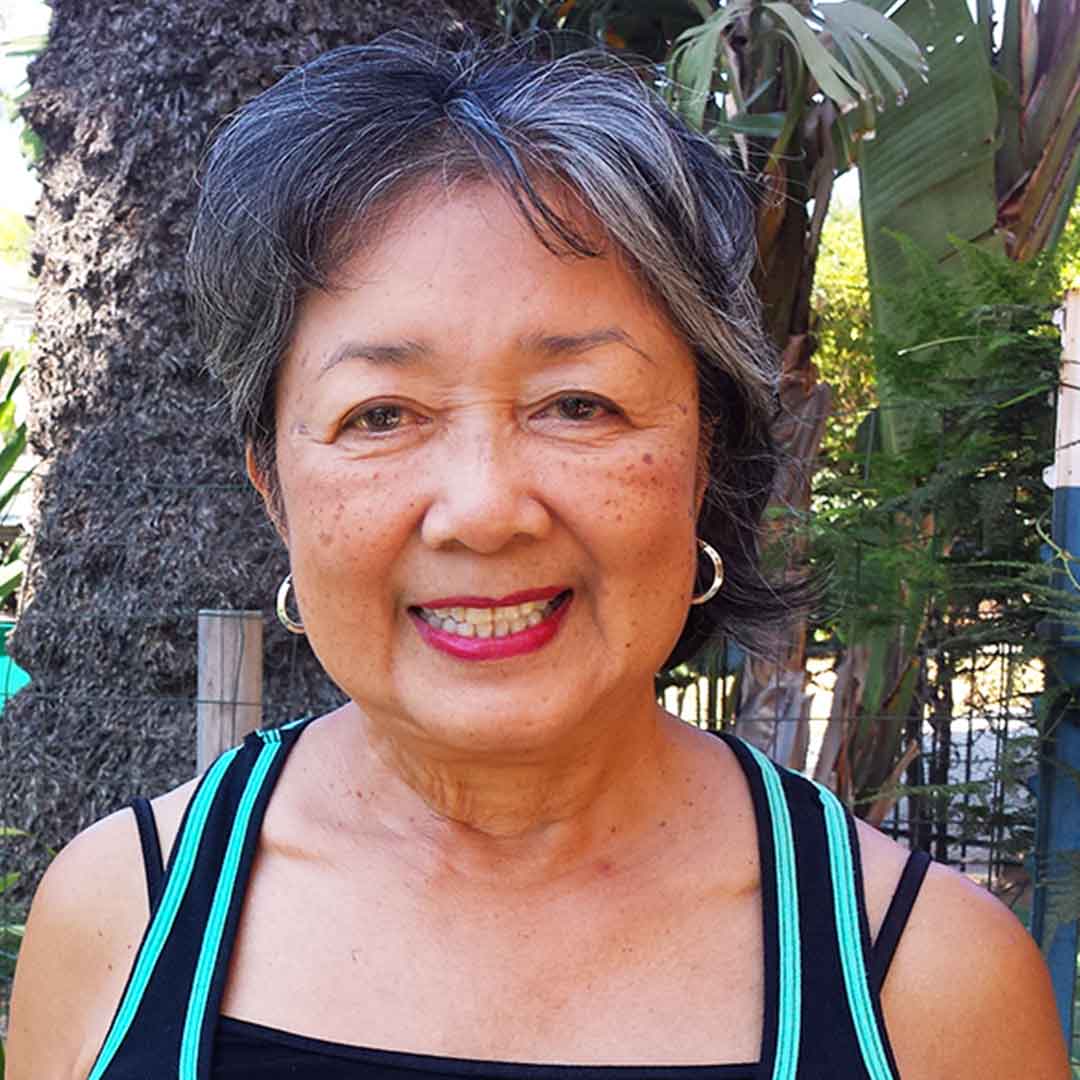
Joselyn Geaga-Rosenthal, Historic Filipinotown community leader, on her connection to Hillary Clinton.
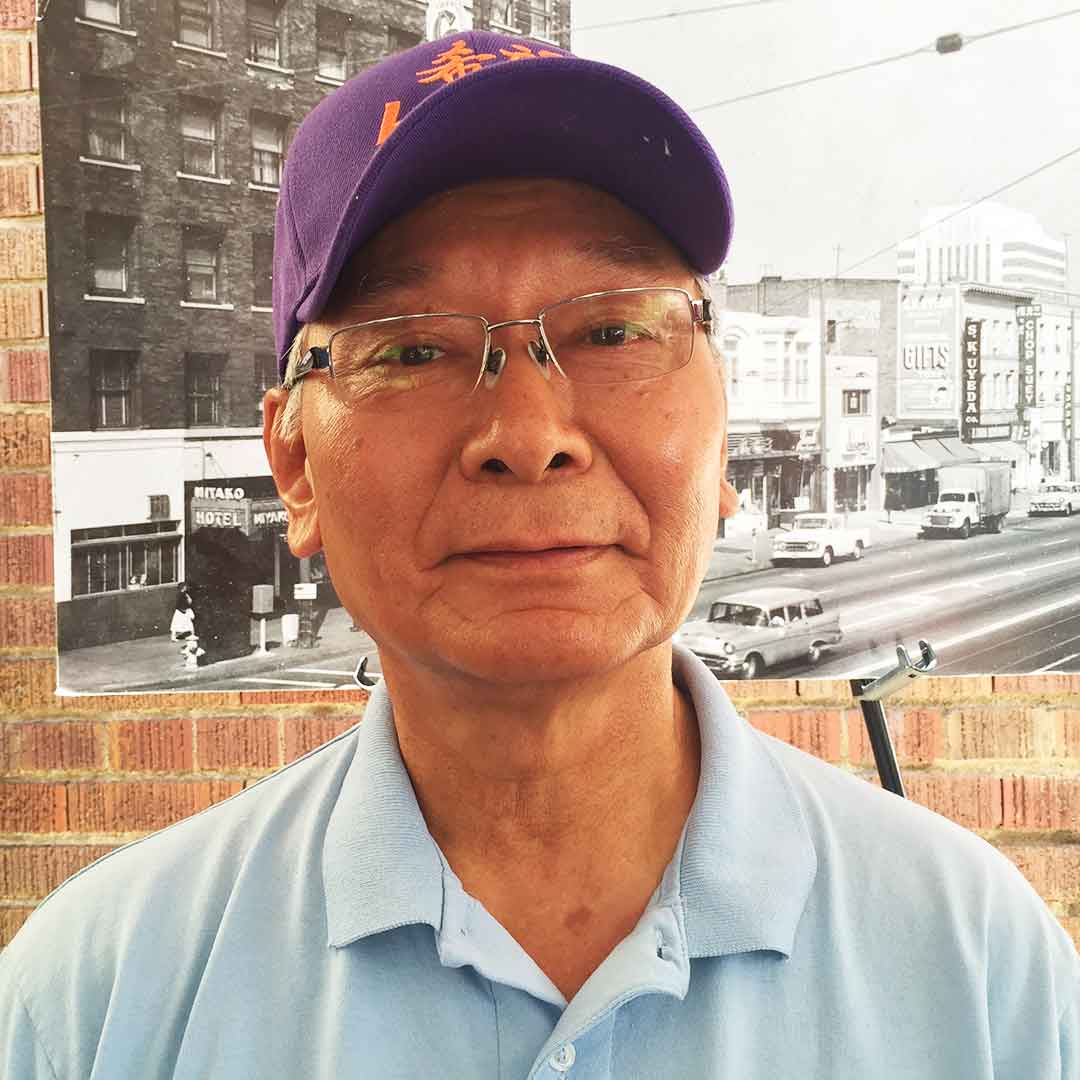
Bill Watanabe, Little Tokyo Historical Society board member, on political issues important to his community.
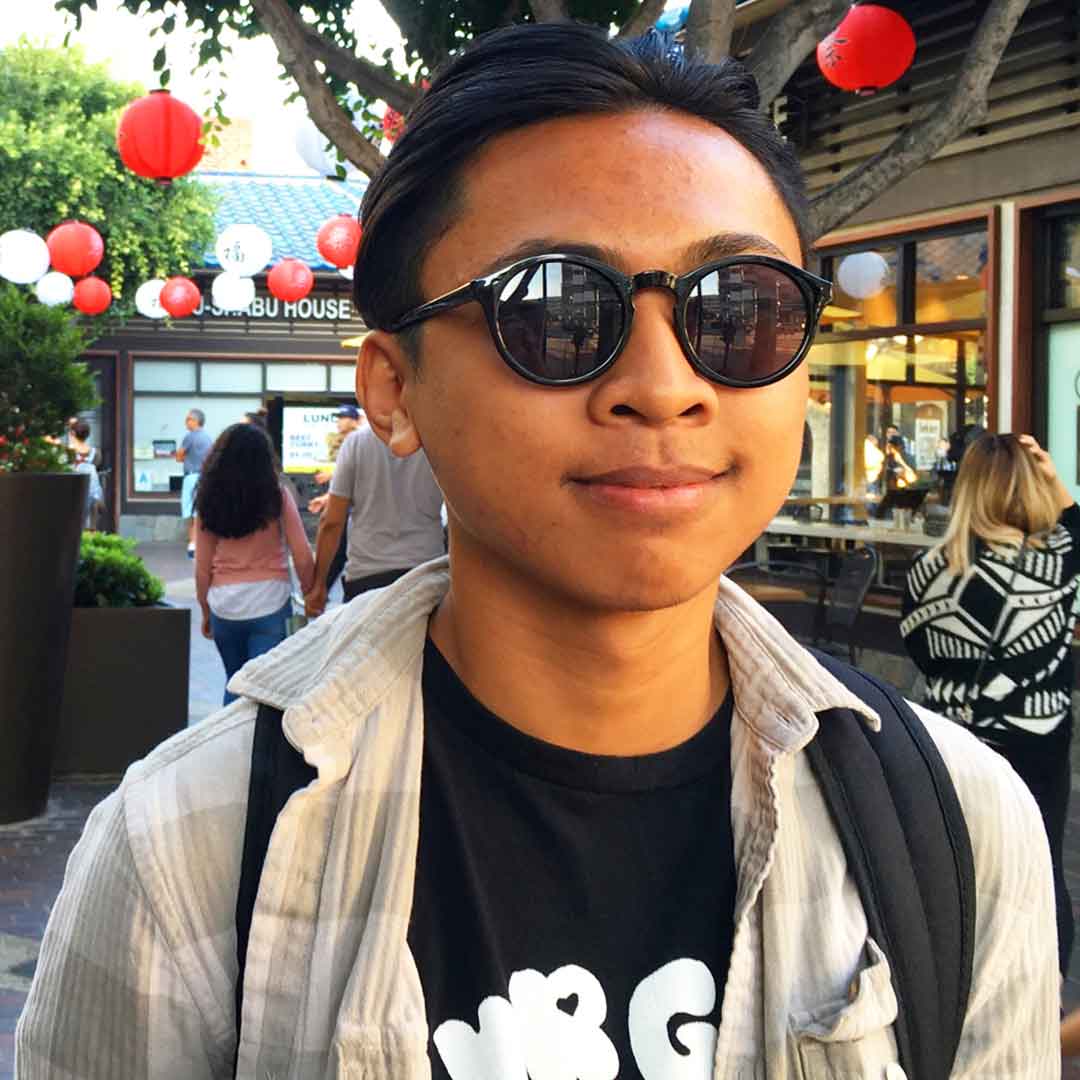
Marcus Lopena, a Filipino-American student, on Trump calling the Philippines "a terrorist nation."
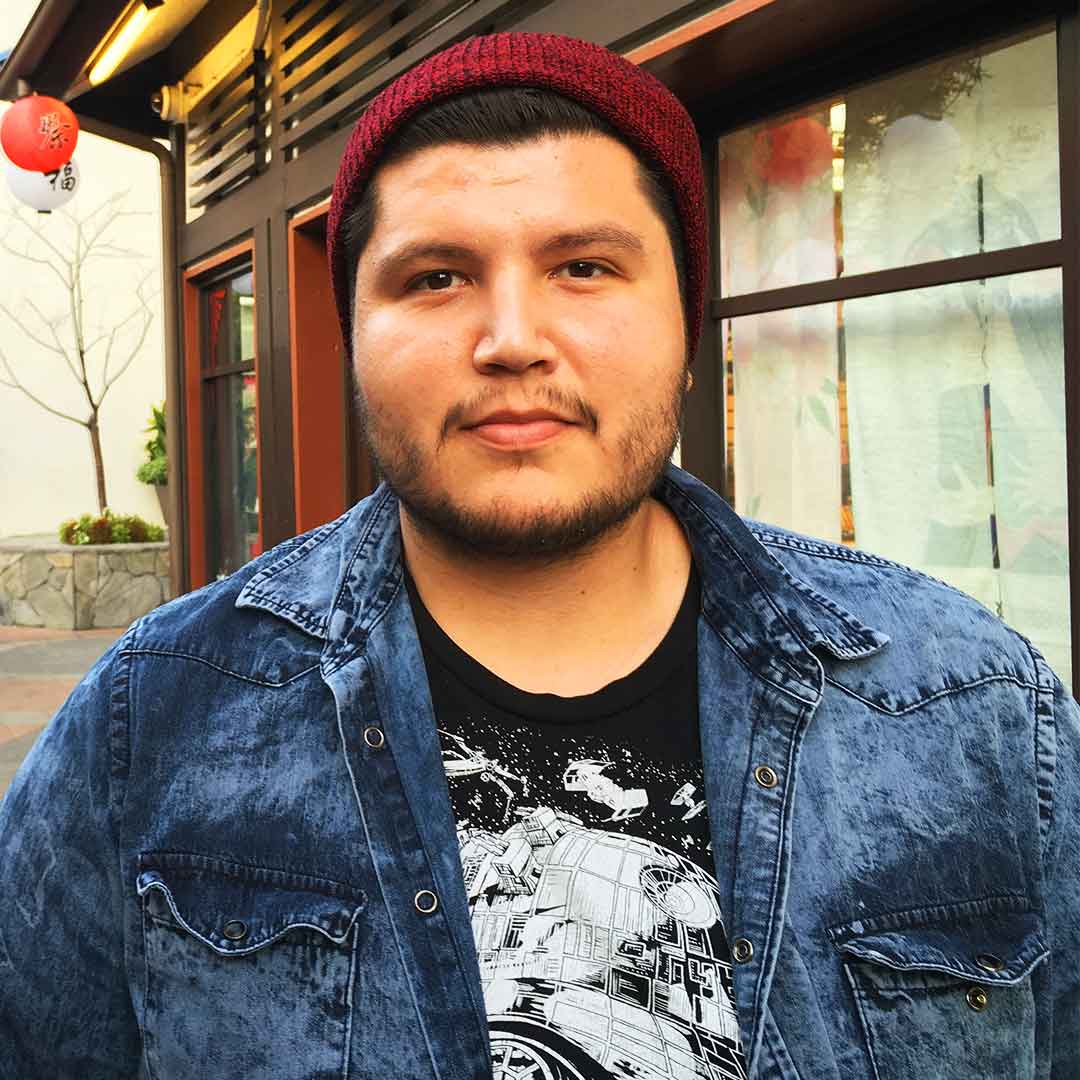
Tim Ramirez, a future aerospace engineer, on voting Trump to preserve military jobs and security.
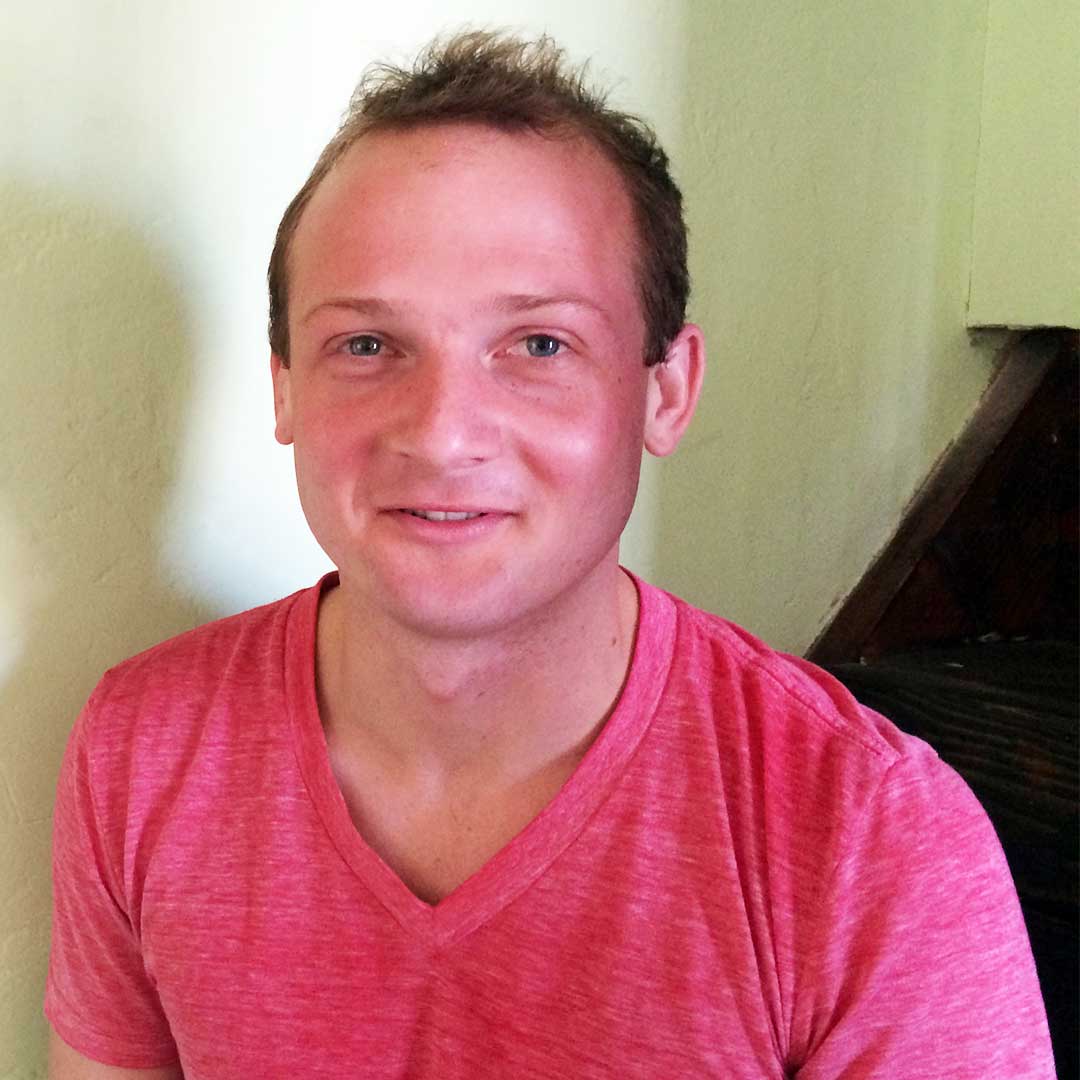
Gene Burinsky, PhD student, on whether a Trump presidency would mimic Vladimir Putin's.
Tatiana Rodzinek, West Hollywood Russian community outreach coordinator, on why Russian speakers tend to vote Republican.
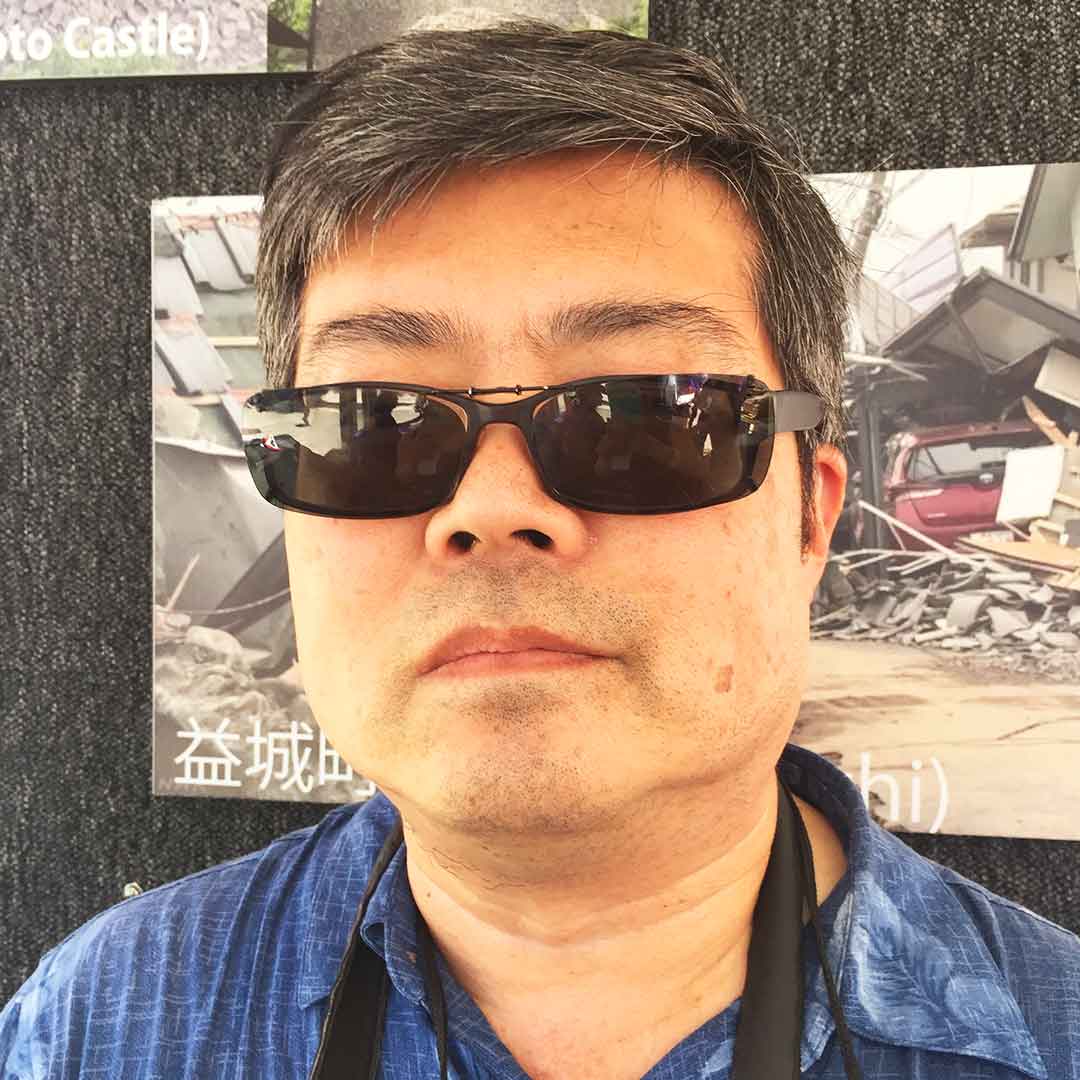
JK Yamamoto, a Rafu Shimpo reporter, compares past treatment of Japanese-Americans with modern-day Islamophobia.
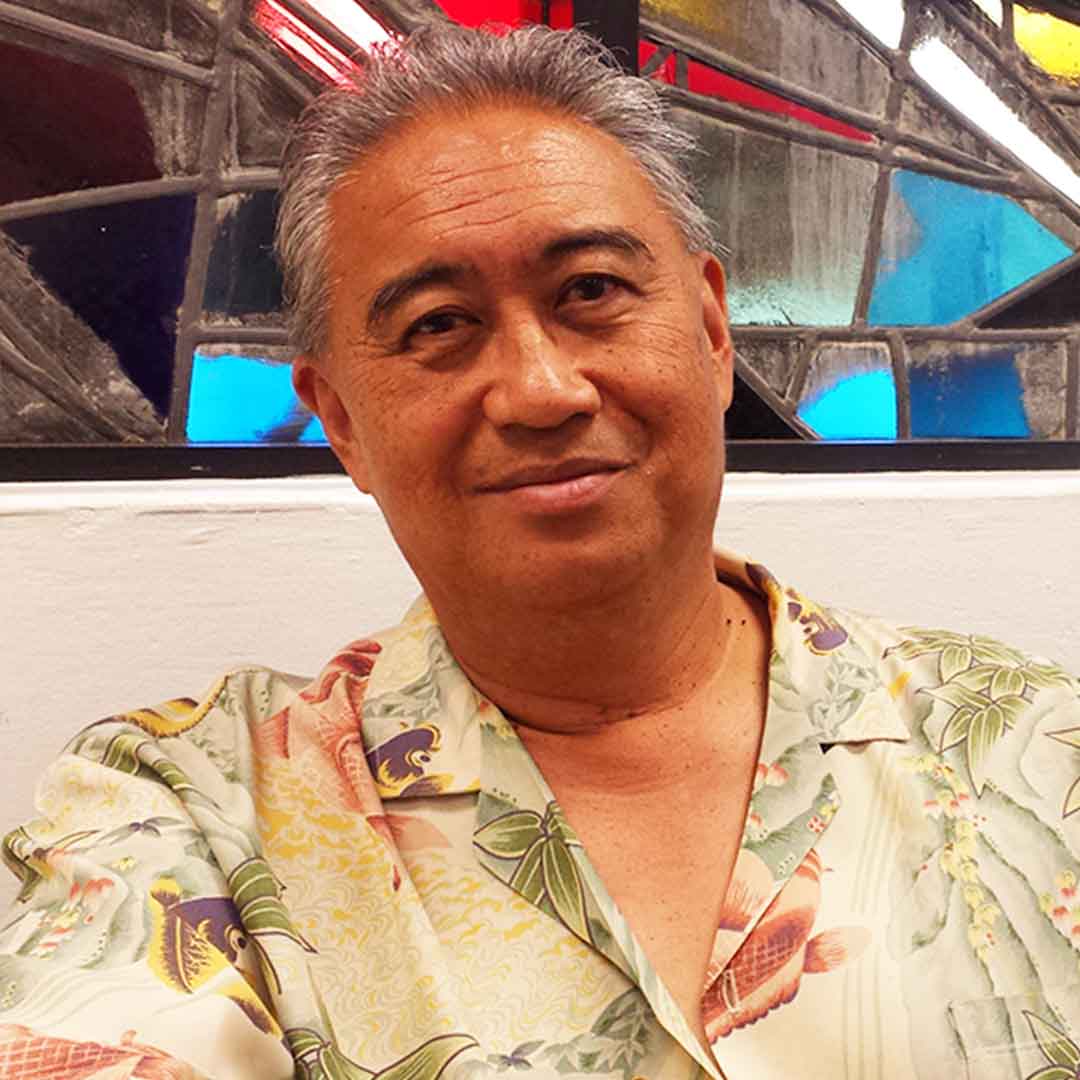
Florante Ibanez, Loyola Marymount University librarian and adjunct professor of Filipino-American Studies, on Filipino conservatism.
Immigration Reform and Visibility are Key Election Issues for Filipino-Americans
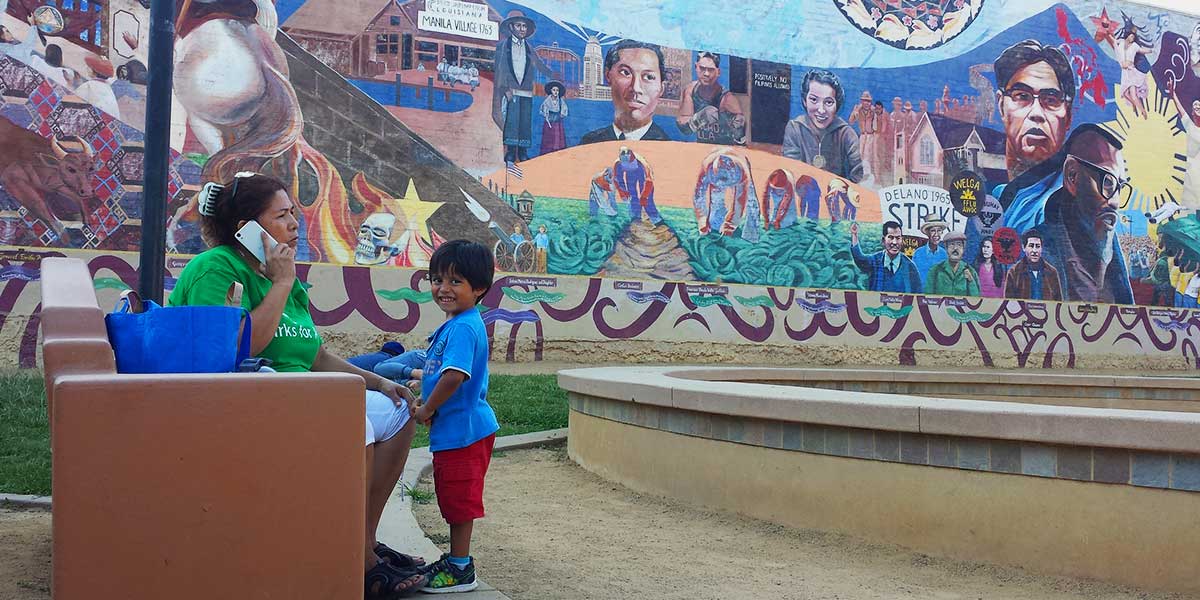
Park visitors near "Gintong Kasaysayan, Gintong Pamana" (A Glorious History, A Golden Legacy), a mural depicting Filipino-American history in Unidad Park in LA's Historic Filipinotown.
By Paola Mardo
Los Angeles is home to the largest population of Filipino-Americans in the country, and they vote at a higher rate than other Asian-Americans, according to two surveys. Yet this community is still thought of as invisible when it comes to politics.
“That’s a lot to do with us as a people. It’s a combination of a lot of things in the way we came to the States, in the way we assimilate, in the way we speak the language,” said Ryan Carpio, president of Pilipino American Los Angeles Democrats (PALAD) and a policy manager for LA Mayor Eric Garcetti.
In 2012, about 68 percent of Filipinos in Los Angeles cast ballots on Election Day, compared to 72 percent of all registered voters, and 65 percent of Asian-American registered voters, according to a survey by Asian Americans Advancing Justice – Los Angeles.
Most Filipino-American voters also skew blue. The survey also found that in terms of party affiliation, 42 percent of 2012 voters were registered Democrat, 26 percent were registered Republican, 27 percent were not registered with any political party, and 5 percent were registered as “other."
Major political upheavals like the dictatorship of Ferdinand Marcos in the 1970s forced many to escape to the U.S. for a better life. Given this history, Filipino-Americans are particularly interested in immigration reform.
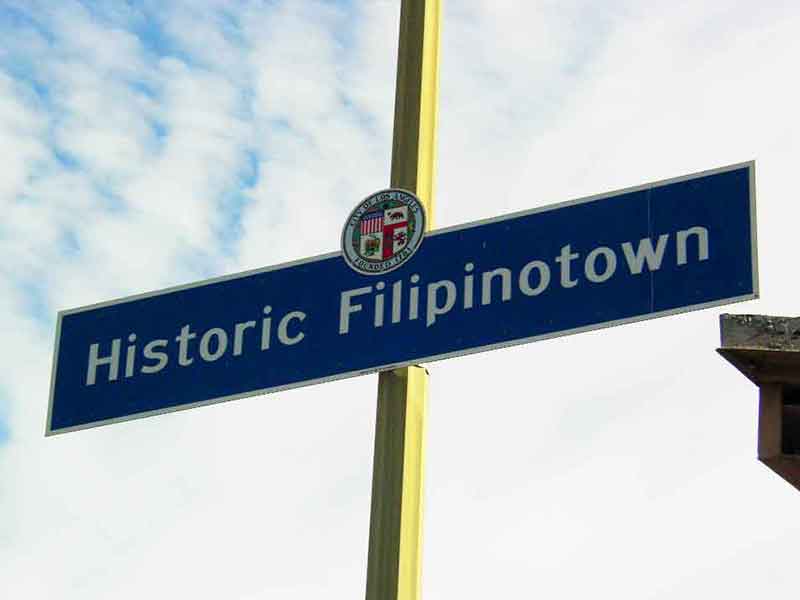
A sign for Historic Filipinotown, an LA district in the southwest portion of Echo Park. The district was designated by a resolution proposed by then-City Councilman Eric Garcetti on Aug. 2, 2002. (Courtesy of Florante Ibanez.)
Filipinos began migrating to the U.S. as early as 1587, when a group arrived in Morro Bay. The first significant wave of Filipino immigrants landed in the early 1900s when Filipino men first immigrated to various parts of California as farm laborers.
They came to the U.S. in search of the American dream, only to be met with racism and anti-miscegenation laws.
Greg Villanueva, co-editor of the book "Filipinotown: Voices from Los Angeles," calls this first wave of Filipinos the “invisible generation,” also known as the "manongs” or “uncles” who gathered in “bachelor societies.” This formed the beginnings of LA’s Filipino community, based at that time in a red-light district downtown now known as Little Tokyo.
When women and families began arriving in the 1950s, many Filipinos migrated to the area west of downtown now designated as Historic Filipinotown. Following the passage of the Immigration Act of 1965, more waves of Filipinos immigrated over the decades.
Today, census figures show that Filipino-Americans are the second largest Asian-American group in Los Angeles, and the third largest Asian group in the country following Chinese and Asian-Indians.
Immigration and timing are factors that have influenced the political behavior of many Filipino-Americans.
“Many of the older generation are conservatively minded because of their, I guess, desire to show that they’re more American than Americans,” said Florante Ibanez, a librarian and adjunct professor who teaches a course on Filipino-American history at Loyola Marymount University.
Ibanez’s parents are Filipino immigrants who worked for the U.S. Navy and tend to be more conservative. But he is part of a more liberal generation of Filipino-Americans who grew up mostly in the U.S. and became politically conscious about their identities as Filipino-Americans in the 1970s.
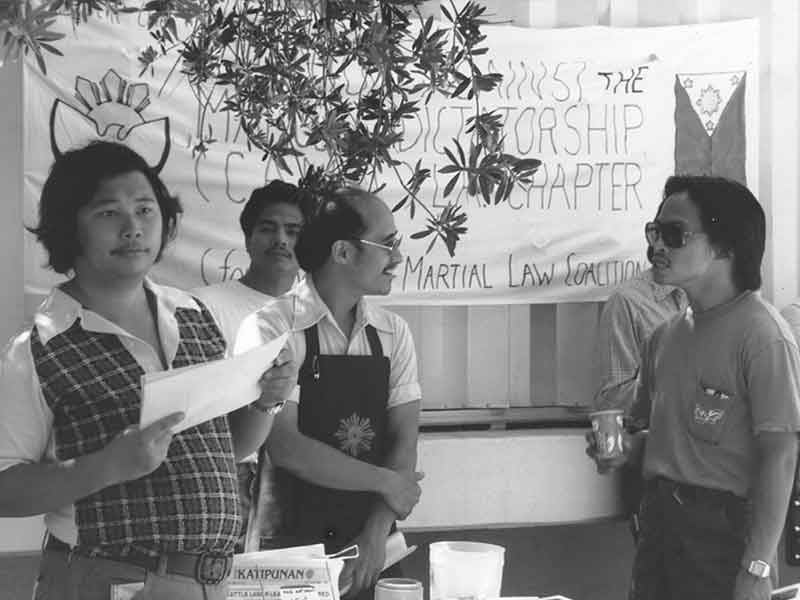
Filipino-American members of the Coalition Against the Marcos Dictatorship in Los Angeles. (Courtesy of Florante Ibanez.)
Leonardo Pandac, on the other hand, is part of a wave of Filipino-Americans who immigrated to the U.S. in the 1980s under the Reagan administration. He is a Republican who believes in strong government and legal immigration.
“I don’t support Donald Trump as a person, but I support the Republican platform,” said Pandac. “Political correctness is on the way out.”
Despite their varied political viewpoints, Filipino-Americans tend to rally around the same issues including affordable health care and immigration reform.
Trump recently added the Philippines to a list of “terrorist nations” whose citizens should be banned from the U.S. Interestingly enough, his campaign chairman, Paul Manafort, worked for Marcos in the 1980s.
“I find (Trump’s) rhetoric really scary, the fact that he can turn a whole group of people against basically ‘othered’ bodies, brown bodies, other bodies of color and that kind of thing,” said Samantha Agoncillo, a rising senior at UC Berkeley who grew up in the San Gabriel Valley and Historic Filipinotown.
“I even heard that he went so far as to say that we’re ‘animals,’ that Filipinos are ‘animals.’ I can’t believe we are really living in a time where it’s acceptable for a leader to say things like that,” she said.
Trump’s statements have made headlines in the Philippines as well. Philippine congressman Joey Salceda filed a bill at Manila’s House of Representatives calling for Trump to be barred from entering the country.
“Filipinos find this as ridiculous as the racist white man who said this, considering how the American FBI says that homegrown white extremist groups are actually more of a threat,” said Laurel Fantauzzo, a mixed-race Filipino-American writer and teacher from Southern California who has taught in the Philippines.
The current Philippine President Rodrigo Duterte was dubbed by the media as the “Trump of the Philippines” during his campaign for his off-the-cuff remarks and brash public persona.
Prior to Duterte’s election in May, Fantauzzo wrote an opinion piece in The New York Times calling Duterte the new “strongman of Manila.” His statements about rape and recent handling of mass drug-related killings have been controversial not only in the Philippines but in the U.S. as well.
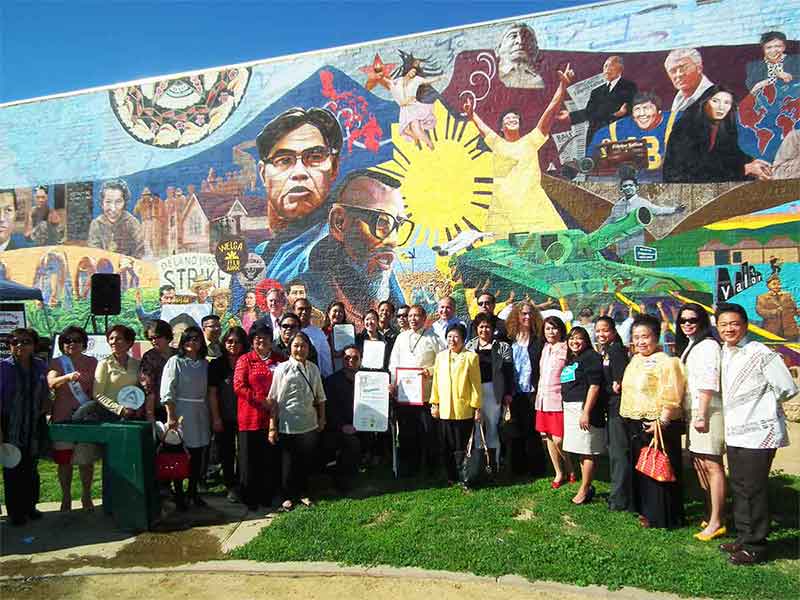
Community leaders and officials gathered to receive a certificate, signed by first lady Michelle Obama, recognizing the Historic Filipinotown neighborhood of LA as a Preserve America Community in 2012. (Courtesy of Florante Ibanez.)
But like many Filipinos in America, Fantauzzo dismissed the comparisons to Trump as simplistic. Filipinos are more concerned with the potential ramifications of Duterte’s actions for U.S.-Philippine relations.
“I can imagine that if human rights abuses continue to run rampant, then U.S.-Philippine relations can be impacted in the future,” said Barbara Gaerlan, assistant director for the UCLA Center for Southeast Asian Studies. “It would be terrible if the U.S. just allowed summary executions of drug suspects by the police in the Philippines to go on without saying anything.”
For now, many Filipinos are holding their breath on what will happen with Duterte, and turning their attention to the upcoming U.S. presidential election.
Joselyn Geaga-Rosenthal, a community leader and founder of PALAD who attended the Democratic National Convention, believes in the importance of voting and getting involved.
“I am committed to a democratic process,” said Geaga-Rosenthal. “But beyond that I’m committed to improving life in Historic Filipinotown, giving homage to our ancestors who contributed to this community.”
PALAD President Carpio said it is important for Filipino-Americans to focus on local elections as well since they can directly influence Filipino-American political representation.
“This is the time to make the impact and let people know, hey, we want a seat at the table. We want to make sure that we have a voice,” said Carpio.
Japanese Angelenos: Why the World War II Internment Matters in the 2016 Election
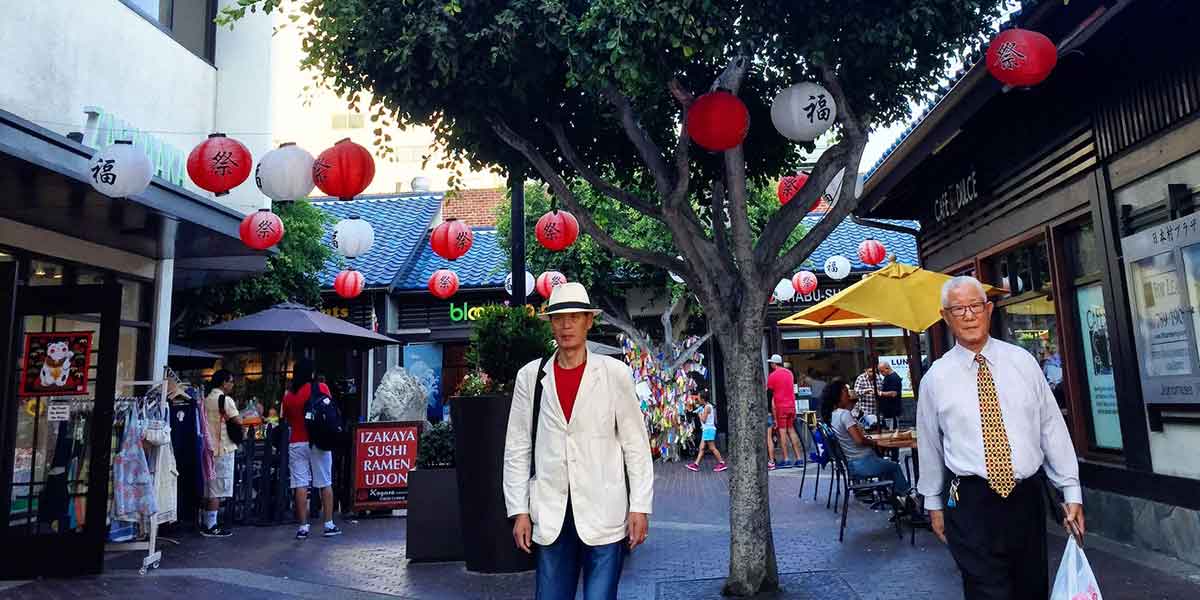
Japanese Village Plaza in Little Tokyo, Los Angeles
By Madison Weil and Cristina Galvan
While many might classify the Japanese internment as an isolated, closed and one-of-a-kind chapter in American history, some have identified disturbing parallels between the cultural and political attitudes of 1942 and the 2016 U.S. presidential election.
“I think there are strong similarities between what happened in 1942 and what’s happening right now. It’s just a different group of people. It’s not Japanese-Americans, it’s Muslims,” said Kristen Marchetti, a Los Angeles resident of Japanese and German descent.
Given their personal experiences with discrimination and internment, Japanese-Americans have more reason to voice their concerns on this subject than other communities.
On Dec. 7, 1941, hundreds of Japanese fighter planes dropped bombs on the U.S. naval base at Pearl Harbor. While the devastating barrage lasted just two hours, its repercussions forever altered the lives of individuals domestically and abroad, and created an atmosphere of fear and mistrust between non-Japanese and Japanese-American citizens.
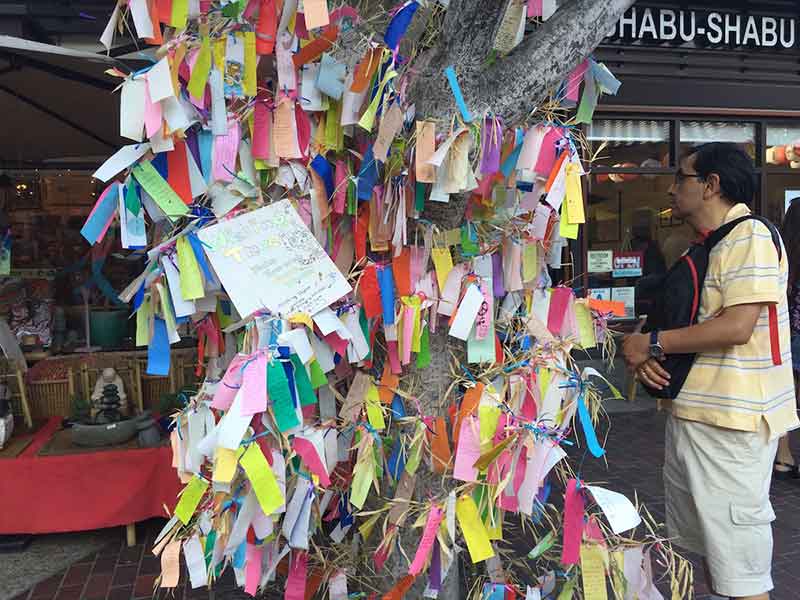
An onlooker reads wishes attached to a tree in front of Blooming Art Gallery where customers can purchase paper for 50 cents to write down their wishes.
As racial tensions increased, the Japanese community in the U.S. experienced oppression and discrimination. One law imposed a curfew from 8 p.m. to 6 a.m. on all individuals of Japanese descent. The FBI imprisoned several prominent Japanese-American figures for supposedly aiding Japan. And many people lost their jobs.
This culture of fear eventually led to the ordered removal of Japanese-Americans from their homes and their placement in internment camps when President Franklin D. Roosevelt signed Executive Order 9066 on Feb. 19, 1942.
The order removed Japanese people from the West Coast and created isolated military areas where “the right of any person to enter, remain in, or leave shall be subject to whatever restrictions the Secretary of War or the appropriate Military Commander may impose in his discretion.”
After receiving an order to relocate, these U.S. citizens had one week to gather their belongings and prepare for the abandonment of their homes and businesses. They then reported to various assembly centers while they awaited relocation to designated internment camps.
While in the camps, prisoners were housed in crowded barracks with small rooms and no plumbing. Despite abysmal conditions, a sense of community developed within the camps. Children went to school, adults worked around the camp, and churches, sports teams, beauty parlors and newspapers opened.
Some individuals were allowed to return home in 1945, but it wasn’t until March 1946 that the last camp was officially closed.
Since then, the U.S. has seen the emergence of a similar widespread fear along with the rise of radical Islam. On Sep. 11, 2001, 60 years after Pearl Harbor, almost 3,000 people were killed in one of the deadliest terrorist attacks in U.S. history. The attack was carried out by al-Qaida, an Islamic extremist group, on the World Trade Towers in New York City and the Pentagon in Washington, D.C.
In light of frequent and recent Islamic terrorist attacks around the world, national security has moved to the forefront of the 2016 presidential election.
In December 2015, Republican presidential nominee Donald Trump called for a “total and complete shutdown” of Muslims entering the United States. He defended this call by comparing himself to Roosevelt’s executive order calling for the Japanese internment following the post-Pearl Harbor hysteria.
"This is a president highly respected by all, he did the same thing," Trump said. "If you look at what he was doing, it was far worse. … We are now at war. … We have a president that doesn't want to say that, but we are now at war.”
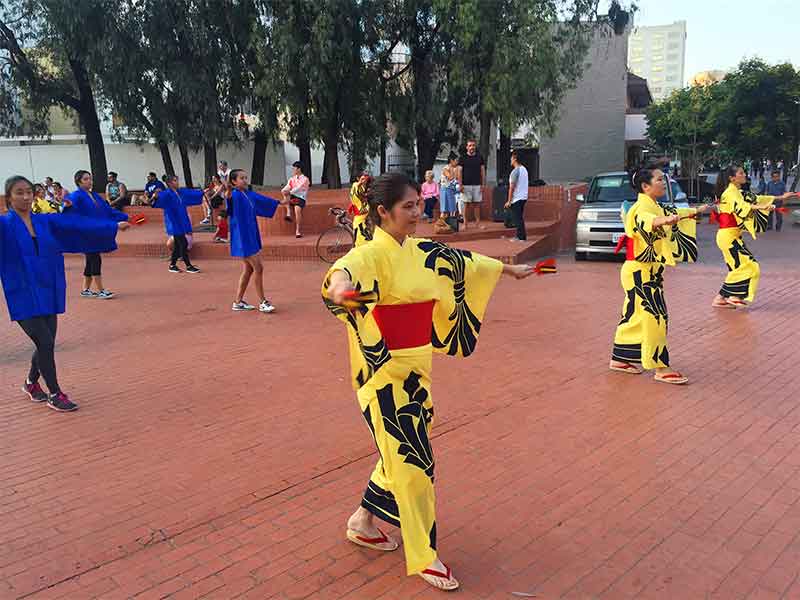
A group performs classical Japanese dances at the Japanese American Cultural and Community Center in preparation for the Nisei Week festival.
Trump told Time magazine that he does not know whether or not he would have supported the Japanese internment. “I would have had to be there at the time to tell you, to give you a proper answer,” he said. Despite being pressed multiple times by MSNBC to discuss whether or not the internment violated American values, Trump refused to respond.
Marchetti, whose grandparents were both interned in the Topaz Relocation Center in Utah, was surprised that Trump neither dismissed nor disagreed with the concept of the internment.
“Wouldn’t you say, ‘Yes, that happened and that was wrong?” she asked.
Marchetti said Trump is not the type of person she wants as her leader and she believes there are better ways to deal with immigration while also protecting national interests and safety. “We’re a country built on immigrants and immigration. To say that we’re not going to allow people into our country is ridiculous,” she said.
San Fernando Valley resident George Wakiji was only 13 years old when he was sent to Gila River Relocation Center in Arizona. He also finds parallels between 1942 and today. “At 13 you don’t know too much. It was only when I got older that I realized what my government had done to me. And that’s when I became more vocal,” he said.
When asked what issue is most important to him in this election, Wakiji laughed and said, “My important issue is to make sure Donald Trump doesn’t get elected president. I think that [an internment] could happen again. When I went out and spoke to students I told them, ‘If we aren’t vigilant, this could happen again to you.’”
While not all Japanese Angelenos are Democrats, Wakiji said that overall they have more liberal leanings. He is impressed with local Japanese-Americans, and their ability to be inclusive and accepting of different groups. He encourages this kind of tolerance and acceptance among all communities, and identifies this as the key to a unified society.
“We have many people in the United States still that have deep prejudice against different people — people of color, people of religion, and so forth,” said Wakiji. “The young people have to be leaders in this sense and speak out against these kind of things happening.”
Russians in LA: Back in the USSR?
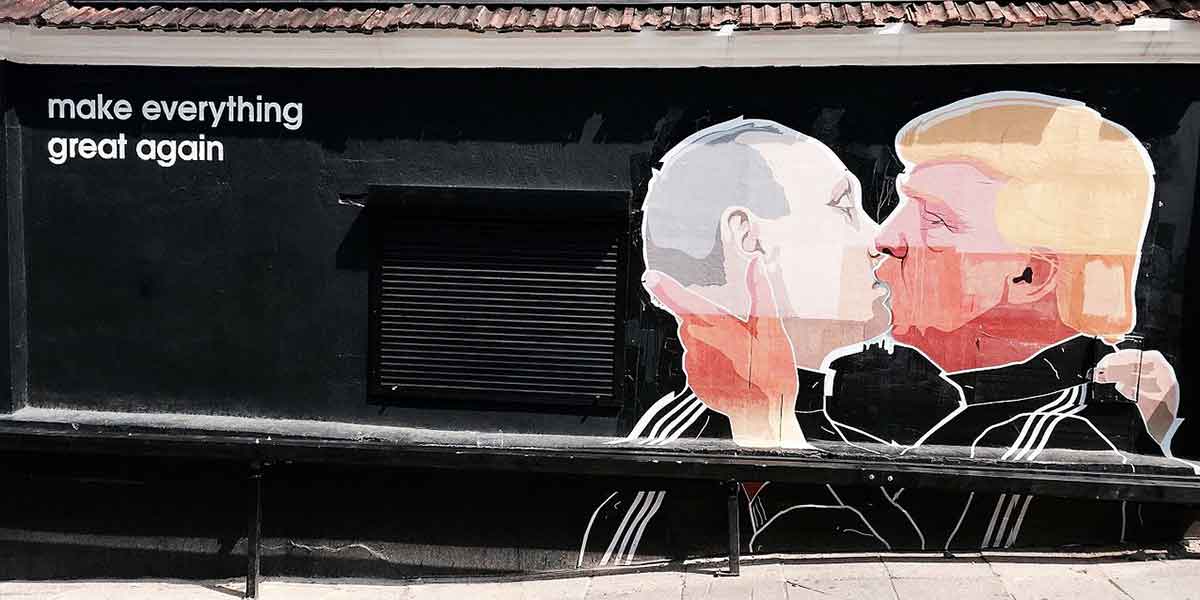
A satirical mural in Vilnius, Lithuania, by the artists Dominykas Čečkauskas and Mindaugas Bonanu, depicting Trump and Putin locked in a warm embrace. (Photo by Rasagri / CC BY-SA 4.0.)
By Jenny Lower
After a brief post-Cold War thaw in U.S.-Russian relations, the former Soviet Union has resurged as a primary American foreign policy concern, thanks in part to Republican presidential nominee Donald Trump.
Since the 1999 election of current Russian President Vladimir Putin, a former KGB intelligence officer, Moscow has consolidated its power, cracked down on free speech and the press and asserted its interests abroad, climaxing with the 2014 annexation of Crimea, a largely Russian-speaking peninsula in Ukraine along the Black Sea.
In the current election cycle, Russia has again become a flashpoint following a series of incidents mostly tied to Trump.
In recent months Trump has drawn criticism for repeatedly voicing his admiration for Putin, referring to him as “a strong leader…a powerful leader” and “my new best friend” and claiming Putin praised him as “brilliant.” (Putin himself has disputed that characterization of his remarks, though he has called Trump “a very lively man, talented without doubt.”)
The two men’s apparent warmth and mutual admiration has led some voters to worry that Trump may emulate Putin’s suppressive tactics once in office.
Those fears intensified in late July, when Trump stunned lawmakers on both sides of the aisle by calling on Russia to hack into his Democratic opponent Hillary Clinton’s emails. “Russia, if you’re listening, I hope you’re able to find the 30,000 emails that are missing. I think you will probably be rewarded mightily by our press.” Trump later said his comments were meant to be “sarcastic.”
Trump called on Russia to hack Hillary Clinton's emails at a press conference on July 27, 2016, in Miami.
Shortly thereafter, a hacker referring to himself as “Guccifer 2.0” broke into the Democratic National Convention’s email system. The exposure of the emails, demonstrating bias by party officials against Hillary Clinton’s primary opponent, Vermont Senator Bernie Sanders, led to the resignation of DNC Chairwoman Debbie Wassermann Shultz. Subsequent cyberattacks have led to a widening FBI investigation and caused the Clinton campaign to accuse Putin of trying to influence the U.S. election.
In the wake of those incidents, Trump has caused more controversy by appearing to rubber-stamp, or be ignorant of, potential Russian expansion. Just before accepting the Republican nomination, Trump suggested he might not automatically come to the aid of NATO members who are threatened by Russia, causing consternation among former Soviet countries in the Baltic region. And in a July 31 interview with ABC news anchor George Stephanopoulos, Trump claimed Putin “wouldn’t get into Ukraine,” even though Russia annexed Crimea after a popular referendum (widely discredited by the international community) two years ago.
Trump’s Ukraine comments come at a particularly critical time. Russia has been gradually militarizing its army, and in early August Putin said he would increase Russia’s military presence in Ukraine in response to an alleged terrorist attack in the region. Ukrainian and U.S. officials have dismissed the Russian account as “fantasy,” but onlookers have speculated that Putin might use the accusation as a pretext to invade.
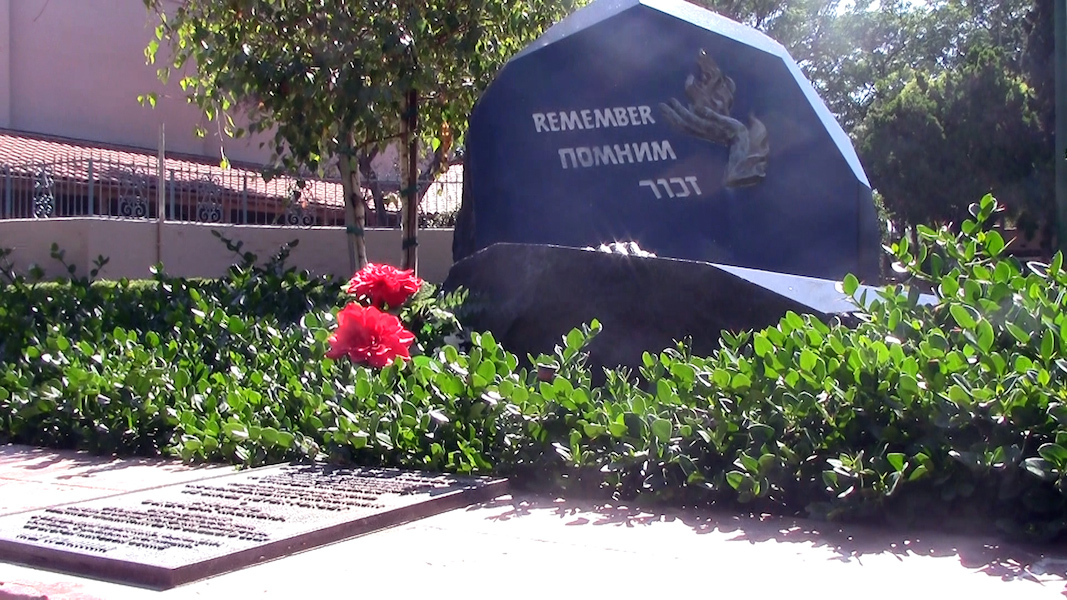
Plummer Park is home to a World War II memorial that honors soldiers from the former Soviet Union. It is only monument in the U.S. to honor veterans of a foreign army.
In Los Angeles, the Russian-speaking community is most visibly concentrated in West Hollywood, a nearly two-square-mile, L-shaped strip of land where they make up 11 percent of the population, or about 4,000 people.
Many residents came to the United States from the then-Soviet Union as Jewish refugees between 1975 and 1984, according to the city of West Hollywood. Known as refuseniks, they were denied employment at home and relocated to the United States for safety and economic opportunity.
Dotted with Russian businesses with Cyrillic names above the door, the West Hollywood community remains relatively insular. Many residents and proprietors there speak primarily Russian, and local businesses, including grocery stores, pharmacies and bookstores, provide opportunity to socialize.
The city of Los Angeles has more than 60,000 people who claim Russian descent, though they remain dispersed across a wide geographic area. While Russians have a reputation as a private people, the politics of their native country have come under increasing scrutiny.
For Russian-Americans in LA, the legacy of Communism casts a long shadow. Again and again, Angelenos who claim Russian ancestry declined to speak on the record to reporters, cut off in-progress interviews or refused to have their picture taken.
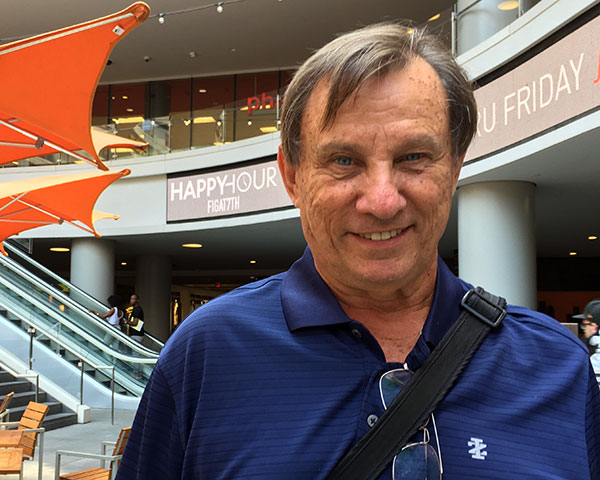
James Scott, who runs a Russian conversation club, after a gathering at FIGat7th in Downtown LA.
Their wariness may be valid. James Scott, who has run a Russian language Meetup group for the past nine years, said he was contacted by a representative of Russia’s Federal Security Service (the KGB’s successor), who claimed to be looking for “enemies of Russia.” Scott assured him the group’s purpose was merely social.
But on and off the record, a few key themes emerged. While the Russian community as a whole tends to be politically and socially conservative — a reaction against the country’s hard left history — many, like their fellow Californians, support Clinton or Sanders. Among those supporting Trump, immigration was cited as a chief concern, as well as the belief that Trump would do a better job creating jobs and managing the economy.
Deeply skeptical of official narratives, Russian voters doubted that Putin was directly behind the DNC cyberattacks, although they didn’t rule out the possibility. And while several people said that Putin’s caginess makes it impossible to know his true motivations toward Trump, virtually no one took Putin at his word when he praised the Republican leader.
At the same time, local Russians seemed skeptical of Putin’s characterization in the American press as a political mastermind, and a couple dismissed any imminent plans to expand into Eastern Europe or Ukraine.
While Trump claims to have no special relationship with Russia, speculation about his campaign’s connections with the country won’t end any time soon. On Aug. 14, The New York Times reported that the name of Paul Manafort — Trump’s campaign manager and a former consultant to Filipino dictator Ferdinand Marcos — was found in a secret ledger in Ukraine. The handwritten document reportedly designated $12.7 million in cash payments to Manafort by his former client, the deposed pro-Russian Ukrainian president, Viktor Yanukovych.
Manafort has denied working for the Ukrainian government or receiving any illicit payments.
Community Map
Click on the icons to view key locations for the Filipino, Japanese and Russian communities of Los Angeles.
How does the election affect YOUR community?
Join the conversation on Instagram, Twitter, and Facebook at #VoiceYourVoteLA
